

When I sat down with Dr Shankara Chetty and Joachim Gerlach, I expected the conversation to centre on Anthony Fauci, the DEFUSE proposal and the renewed argument over whether SARS-CoV-2 emerged from a laboratory (timecodes below).
It did begin there. But I came away thinking that the origin debate, however important, has become a distraction from the problem directly in front of me.
The virus is still circulating. People are still being reinfected. Some appear to recover from a mild illness, only to develop a major clinical problem weeks later. Others never return fully to their previous baseline before the next infection arrives.
That is the question I cannot ignore. Even if I eventually establish exactly how this virus began, what am I doing about what it is still doing now?
A Lab Leak Is Not the Same as an Engineered Virus
I need to begin with a correction, because the language is routinely collapsed into one politically convenient sentence.
A laboratory-related origin would not, by itself, prove that SARS-CoV-2 was engineered. A laboratory incident could involve a naturally collected virus, an adapted virus or an experimentally modified virus. Those are different propositions, but the fact that the information was suppressed makes a simple accident less likely.
The current US White House presents a laboratory-related incident involving gain-of-function research as the most likely origin. The WHO Scientific Advisory Group for the Origins of Novel Pathogens reached a different evidential position in 2025: the weight of available evidence favoured zoonotic spillover, while a laboratory incident could not be excluded because essential data had not been supplied.
I cannot honestly turn that unresolved position into certainty merely because one political institution now states the laboratory hypothesis more confidently than another.
What I can say is that the oversight problem was real. The US Department of Health and Human Services Office of Inspector General found that NIH and EcoHealth Alliance did not adequately monitor relevant awards and subawards, missed opportunities to identify problems and failed to obtain important documentation from the Wuhan Institute of Virology. That is a documented governance failure. It is not, on its own, proof that the funded work created SARS-CoV-2.
“Mild” Was Never a Biological Verdict
The more urgent mistake may be the way the population has been encouraged to interpret Omicron.
Although, Omicron caused less acute severe disease at a population level than the earlier pandemic variants, particularly in populations with accumulated immunity. That is real. But a fall in intensive-care admissions does not mean that every important biological effect disappeared.
Acute severity and post-acute risk are not the same outcome.
The 2026 WHO global risk assessment describes the overall public-health risk as moderate, with severity indicators broadly stable. It does not describe SARS-CoV-2 as biologically harmless. The same WHO material recognises continuing circulation, surveillance gaps and the ongoing burden of post-COVID illness.
This distinction fits what I see clinically. A patient may have a brief respiratory illness and then, two or three weeks later, present with vascular, neurological, inflammatory or metabolic disease. The timing does not prove causation. But if I never record the preceding infection, never ask whether the patient returned to baseline and never examine the temporal sequence, I have designed the association out of my own clinical reasoning.
Reinfection Changes the Arithmetic
The strongest part of our discussion concerned cumulative exposure.
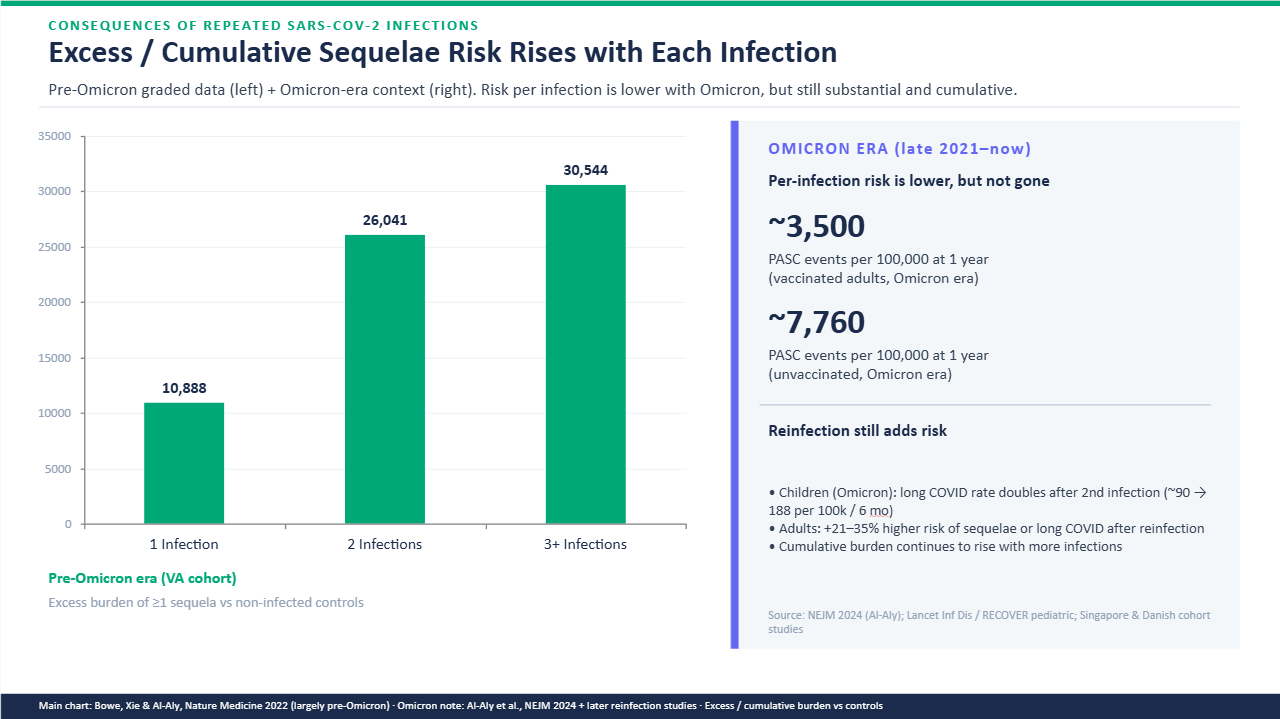
In the 2022 Veterans Affairs analysis published in Nature Medicine, reinfection was associated with additional risks of death, hospitalisation and sequelae across several organ systems, with the cumulative burden rising by number of infections. The cohort was predominantly older, white and male, so I cannot simply transfer every numerical estimate to the general population. But the direction of the signal is difficult to dismiss.
The later New England Journal of Medicine analysis showed that the risk of post-acute sequelae declined across pandemic eras and was lower after vaccination, yet remained substantial among vaccinated people infected during the Omicron era. The WHO long COVID fact sheet now explicitly identifies repeated infection as a factor that increases risk.
I therefore do not think the correct message is that every infection causes permanent damage. The evidence does not justify that. The defensible message is narrower and more important: reinfection is not biologically neutral, and lower average acute severity does not erase cumulative post-acute risk.
Dr Chetty expressed this clinically. He described patients who fail to regain their previous health before the next infection. That is the practical question clinicians should ask: did this patient return to baseline, or are repeated infections progressively lowering the baseline itself?
Spike Persistence: A Real Signal Surrounded by Overreach
Joachim presented data on circulating spike protein. Here I need to separate an important scientific signal from claims the current data cannot support.
Peer-reviewed studies have detected persistent SARS-CoV-2 antigens in subsets of people after acute infection. One study in Clinical Infectious Diseases detected S1, spike or nucleocapsid antigen in approximately 65% of participants with post-acute sequelae at one or more time points. A separate plasma study in The Lancet Infectious Diseases found excess antigen detection for months after infection and supported the possibility of a persistent reservoir in a subset.
That does not mean that two-thirds of the general population have active spike production.
The practice-based Spike Challenge presented in our discussion reported 460 positive and 233 negative results, or 66.4% positivity among 693 evaluable tests. The slide itself correctly states that this was a practice cohort close to a Long COVID population, and that it makes no claim about the general population. Selection bias alone could profoundly alter the result. It would need independent assay validation, clear specificity and cross-reactivity data, stable sampling criteria and a method capable of distinguishing infection-derived from vaccine-derived antigen.
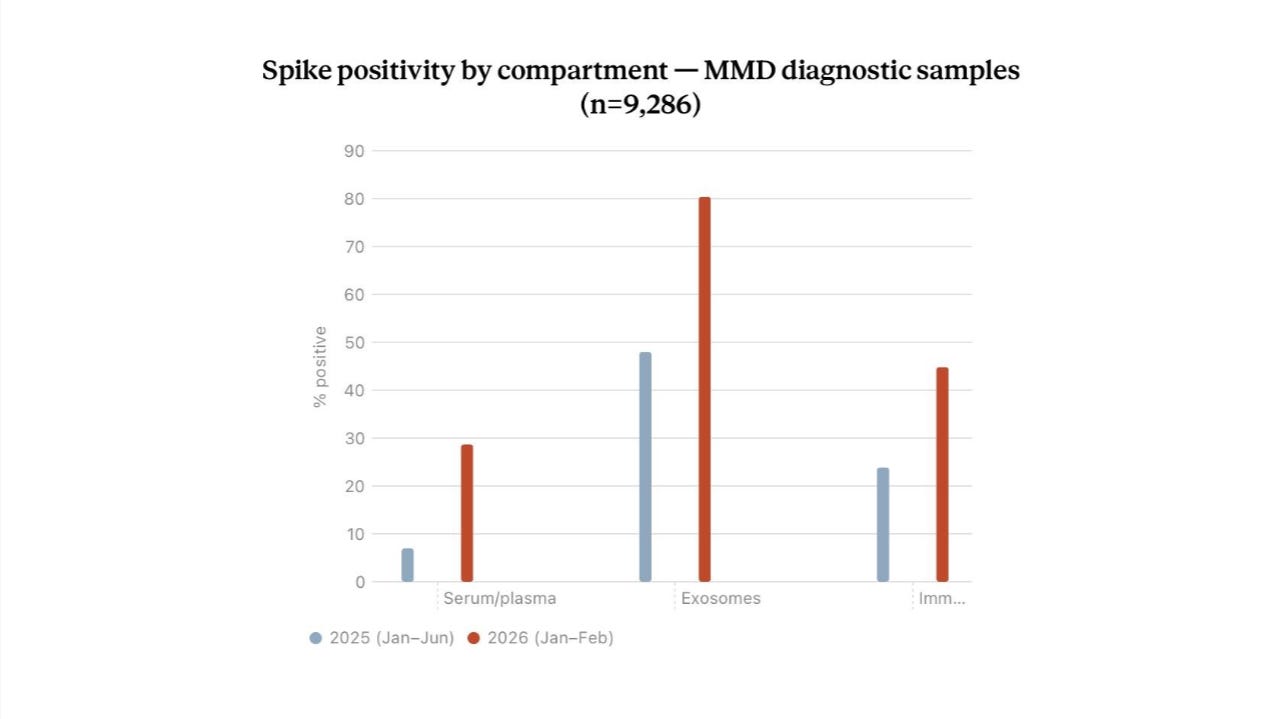
Another slide compared spike positivity in 9,286 diagnostic samples collected in January to June 2025 with samples collected in January and February 2026. The apparent rise is concerning, but the two collection windows and referral populations are not automatically comparable. I cannot conclude that population-level spike production doubled unless the sampling frame, assay performance, clinical mix and denominators were stable.
This is not pedantry. If I criticise public health for overstating certainty and then overstate my own preferred evidence, I reproduce the same failure in a different direction.
Hospital Data Are a Signal, Not a Mechanism
The presentation also showed striking rises in several infectious-disease hospital codes, including mycoplasma, chlamydial, Gram-negative and viral pneumonias. These patterns deserve serious investigation.
But I cannot label them proof of “herd immunodeficiency” from a graph alone.
Hospital episode data are affected by coding practice, laboratory testing, age structure, repeat admissions, service capacity, seasonal circulation, pandemic suppression and rebound, and changes in the threshold for admission. I would want age-standardised population rates, unique-patient counts, pathogen confirmation, pre-pandemic baselines and linked individual-level immune data before moving from temporal association to mechanism.
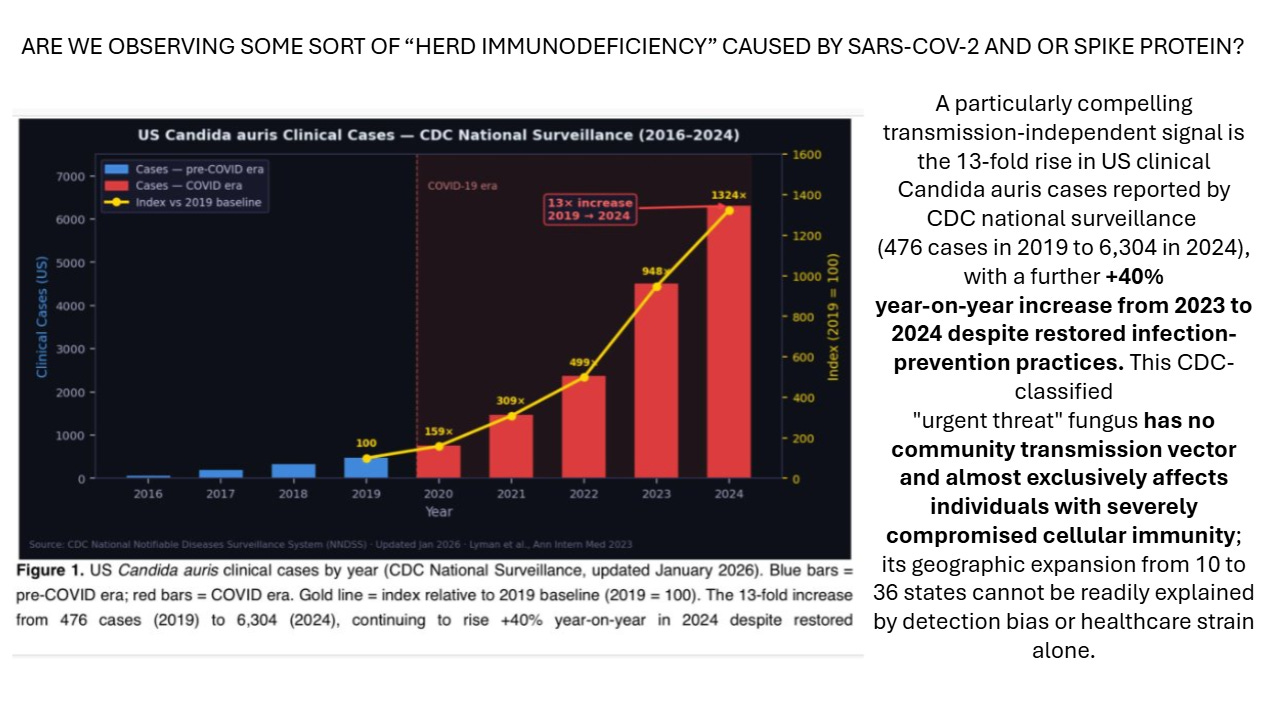
Candida auris is a good example of why this discipline matters. The rise is real: the CDC reported 6,304 US clinical cases in 2024. But the CDC also states that C. auris spreads readily in healthcare facilities and mainly affects people who are already very ill. Its expansion could reflect a mixture of vulnerable patients, healthcare transmission, screening, antifungal resistance and infection-control failure. It does not independently establish population-wide cellular immunosuppression.
I see the hospital trends as hypothesis-generating. I do not see them as a completed causal argument.
The Counter-Narrative Has Its Own Blind Spots
One of the most important moments in the conversation came when we discussed ideology. I have watched institutional narratives suppress legitimate questions. I have also watched opposition to those narratives harden into a new orthodoxy that becomes equally resistant to inconvenient evidence.
The claim that a single infection after vaccination proves a vaccine is ineffective is wrong. It proves that sterilising immunity failed in that person. It does not, by itself, test whether vaccination reduced the risk of hospitalisation, severe disease or death. Current WHO guidance continues to conclude that COVID-19 vaccines reduce severe outcomes, even though protection against infection wanes and is incomplete.
Acknowledging that evidence does not require me to dismiss adverse events, dose-specific risk-benefit questions or the failures of mandates. It requires me to stop pretending that one observation answers a different endpoint.
The measles discussion exposed the same problem. It was suggested that recent outbreaks could not be explained by vaccination gaps and instead pointed towards widespread immune suppression. Yet CDC surveillance shows falling childhood MMR coverage and outbreaks concentrated in communities with low vaccination. In the 2025 Texas hospital cohort, all patients with available vaccination information were unvaccinated or of unknown status. If I ignore that because it does not fit my preferred theory, I am no longer doing science.
I cannot ask the public to reject official dogma while inviting them to accept ours.
What I Think Clinicians Should Do Now
I do not think clinicians should insert “spike” into every differential as though it were a validated diagnosis. I do think post-COVID mechanisms should remain in the differential when the temporal course, multisystem presentation and failure to return to baseline make them plausible.
I would begin with chronology. I want a reliable record of infection, vaccination, symptom onset, partial recovery, reinfection and major clinical events. I want to know what changed from the patient’s previous baseline, and when.
I would then phenotype rather than collapse everyone into one Long COVID label. Severe acute organ damage is not the same as post-infectious immune dysregulation. Infection-only, vaccination-only and overlapping exposures should not be assumed to represent identical biology. Neither should persistent antigen, autoimmune activation, dysautonomia, endothelial injury, reactivated infection and deconditioning be treated as interchangeable explanations.
I would still exclude ordinary disease properly. A post-COVID framework must not become an excuse to miss cancer, pulmonary embolism, endocarditis, endocrine disease, primary neurological disease or a conventional infection. Normal routine investigations also do not prove that nothing is wrong; they may simply show that I measured the wrong layer of biology.
Most importantly, I would collect longitudinal data. A single abnormal biomarker does not tell me whether it is causal, consequential or incidental. Repeated measures linked to symptoms, function, reinfection and treatment are far more informative than a one-off positive result.
The Research Programme I Think We Need
I would start with validated antigen assays tested in blinded, independent laboratories. I would recruit representative community controls alongside clearly defined Long COVID groups, recovered post-infection controls and carefully characterised vaccination-exposure groups. I would record variant, infection number, severity, vaccination timing and immunosuppressive treatment.
I would then link antigen measurements to immune phenotype, endothelial and coagulation markers, autonomic testing, organ-specific outcomes and functional recovery, repeating the measurements over time rather than inferring persistence from a single sample.
For the hospital signals, I would use age-standardised rates, unique patients and laboratory-confirmed pathogens. I would test whether the same individuals show measurable immune dysfunction, rather than assuming that two population curves share a cause because they rose during the same period.
Only after that would I ask whether a particular intervention changes both the biomarker and the clinical outcome.
That is slower than making a confident claim from a striking graph. It is also how I avoid building another narrative that collapses when challenged.
The Question Has Changed
I still want to know how SARS-CoV-2 emerged. The failures of transparency, research governance and public accountability are not historical trivia. They determine whether I can prevent the next pandemic, and whether the public can trust the institutions responsible for doing so.
But origin cannot become the only question.
The clinically urgent issue is that SARS-CoV-2 continues to circulate, reinfection adds risk, post-acute disease remains real, and many patients are still being assessed with frameworks that were never designed for this pathology.
I do not need to prove that every current disease trend is caused by spike protein to justify better surveillance. I do not need to prove population-wide immunodeficiency to investigate unusual infection patterns. And I do not need certainty about viral engineering to recognise that a mild respiratory episode may not be the end of the biological story.
The origin question asks how this began.
The clinical question asks what it is still doing.
I do not have the right to answer the first with certainty. I cannot afford to ignore the second.
Timecodes
00:00 The Pandemic Story Is Not Over
03:00 Was COVID Engineered—and Why Is This Emerging Now?
06:56 The Virus May Be Mild, but Is the Damage?
09:45 What Changed When Omicron Arrived?
13:33 Who Needs to Understand the Continuing Risk?
16:48 Can Circulating Spike Protein Be Measured?
20:55 When Political Narratives Replace Scientific Thinking
24:26 How Public Health Lost the Public’s Trust
28:11 New Spike Data—and Its Serious Limitations
31:23 Why Routine Blood Tests May Miss Post-COVID Disease
35:50 Can the Body Continue Producing Spike Protein?
40:33 What Happens When Chronic Illness Becomes Untreatable?
42:18 How Reinfections May Accumulate Long-Term Damage
47:45 Spike Protein, Antibodies and Opportunistic Infections
57:16 From Immune Dysregulation to Possible Solutions
Vejon COVID-19 Review is reader-supported. No advertisers, no institutional funding, no obligation to reach a particular conclusion. Subscribe free for new posts, or paid to support the work directly.


