

Canada is doing something important.
Between 8 and 11 September 2026, the Allison Inquiry is listening to Canadians who believe COVID-19 vaccination injured them. Chaired by Member of Parliament Dean Allison, the hearings are broadcast from Parliament Hill in Ottawa.
I need to be precise about what this inquiry is. Its own terms of reference describe a neutral forum for personal experience, explicitly not intended to make findings of fact or reach conclusions.
That distinction matters. Testimony alone cannot prove that vaccination caused an illness. But the absence of definitive proof does not make the illness imaginary, the temporal relationship irrelevant or the person undeserving of investigation and support.
The inquiry is not the end of the scientific process. It is where the process should begin.
Listening Is Different From Proving
I initially suggested that other national inquiries had not allowed vaccine-injured people to present their experiences. That was too broad. The UK COVID-19 Inquiry heard from Vaccine Injured and Bereaved UK and other affected groups in Module 4.
What distinguishes the Allison Inquiry is not that these people have never been heard elsewhere. It is that hearing them is its central purpose.
That matters, because these patients describe a second injury beyond the physical one. They became unwell, raised the possibility of a connection, and found the question itself treated as unacceptable.
Medicine must be able to hold two ideas at once. An illness occurring after vaccination was not necessarily caused by vaccination. But it is equally wrong to assume vaccination could not have caused it simply because causation is difficult to prove.
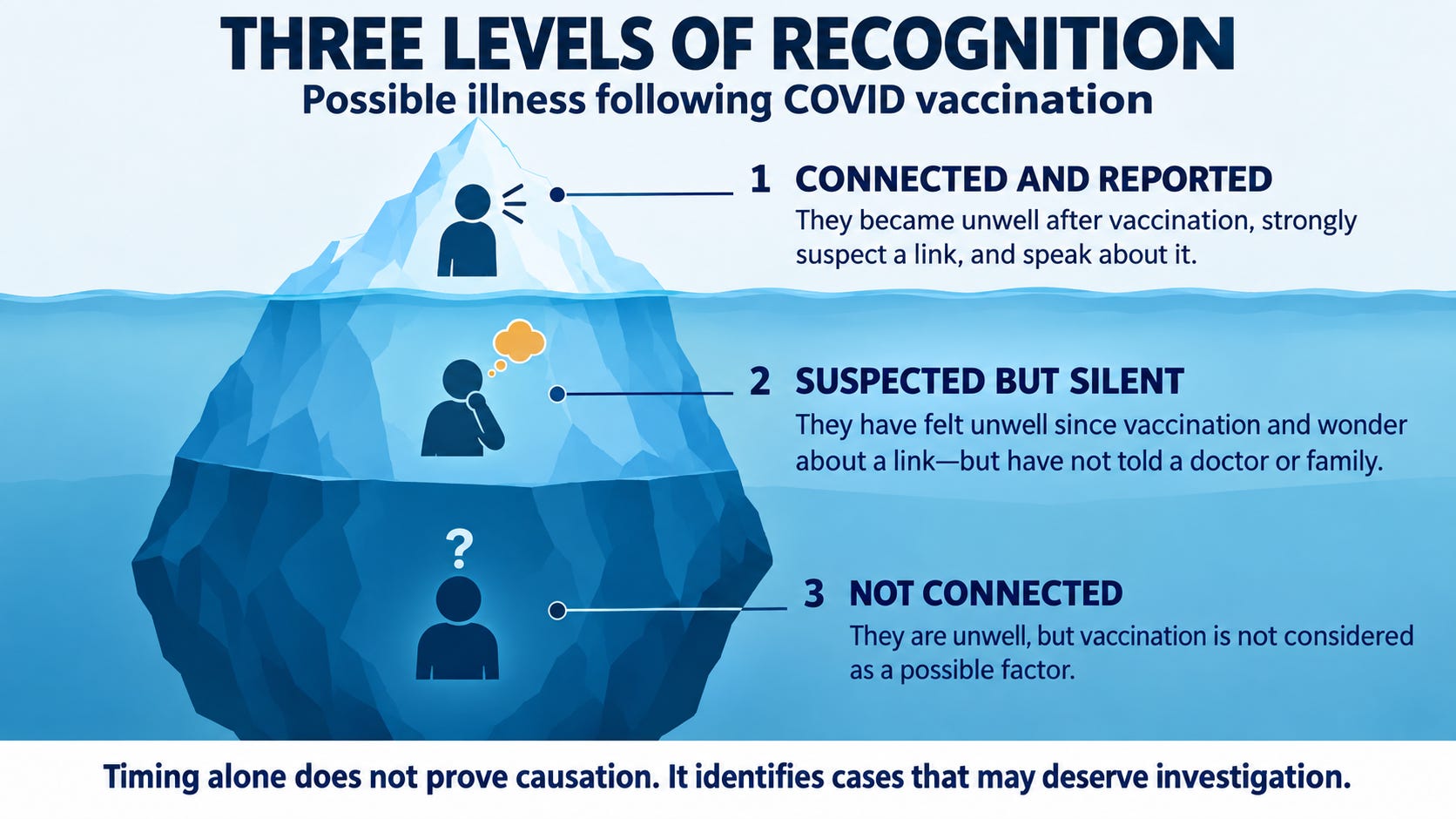
Temporality is not proof. It is a signal that should initiate investigation.
What the Canadian Numbers Actually Show
The Canadian government’s figures are revealing, and easy to misrepresent.
According to the Public Health Agency of Canada, the former Vaccine Injury Support Program received 3,557 claims between June 2021 and 30 November 2025.
Of those, 3,018 were considered admissible, 1,433 had been assessed by a Medical Review Board and 252 had been approved. There were also 551 appeals, of which 163 had been assessed and 11 approved. Approximately 2,000 existing applications were subsequently transferred to the new Vaccine Impact Assistance Program for further processing.
So it is wrong to say that everyone apart from the 252 was rejected. Many applications remained inside a prolonged administrative and medical-review process.
The opposite conclusion is also wrong.
The 3,557 applicants cannot all be counted as confirmed vaccine injuries. A claim records a person’s belief that vaccination caused or contributed to an illness. It does not establish causation.
The federal figures cover eligible injuries following all Health Canada-authorised vaccines administered after December 2020, not exclusively COVID-19 vaccination, and they exclude Quebec, which operates a separate programme.
The number 252 is neither the total number injured nor a reliable estimate of prevalence. It is the number that had passed a particularly narrow administrative and medical threshold by that date.
Why the Compensation Threshold Is So Difficult
Canada’s current Vaccine Impact Assistance Program requires an injury to be serious, permanent and probably caused by vaccination. That is a far higher threshold than reporting an adverse event.
In safety surveillance, uncertainty is a reason to report. Canadian guidance is explicit that an adverse event following immunisation need not be proven vaccine-caused, and that clinicians should report even when uncertain.
In compensation, uncertainty often becomes a reason not to approve. The gap this creates is uncomfortable. A patient may be ill enough to lose their working life, but unless the medical evidence establishes probable causation, the system may still exclude them.
From an adjudication perspective that is understandable. A government programme cannot treat every illness occurring after vaccination as vaccine-caused.
It becomes a serious problem when the necessary research, biomarkers and clinical frameworks were never developed. Patients are asked to prove a mechanism that medicine has not adequately investigated.
Get Your FREE Chapters Here >
The Three Levels of Recognition
I have come to think of this as an iceberg with three levels.
These are not three grades of proven vaccine injury. They are three levels of recognition.
The first is visible above the water.
These people were well or stable before vaccination, became unwell afterwards, strongly suspect a connection and say so publicly. They report the event, tell their doctors, apply for compensation, give testimony.
They are the people we can see.
The second sits below the surface.
These people have felt unwell since vaccination and privately wonder about a connection. They noticed the timing but have never raised it with a doctor, a partner or their family.
Some are afraid of being dismissed. Others do not want to be labelled anti-vaccine. Some supported vaccination and find it difficult to reconsider a decision they believed was responsible.
I have met people who disclose it only in a quiet moment, almost unexpectedly. “I have wondered whether the vaccine had something to do with it.”
They will not appear in official reporting data, because they never reported anything.
The third level is the deepest and potentially the most important.
These people are unwell but have never considered vaccination a factor. Their symptoms may have begun after vaccination, but no one constructed the timeline. The clinician did not ask. The patient did not think it relevant.
They may carry a diagnosis of fatigue, fibromyalgia, functional symptoms, anxiety, dysautonomia, neuropathy or unexplained inflammatory illness, with no one returning to the period when the symptoms began.
I suspect this third group could be substantial.
But I cannot honestly say it is the largest, because it has never been measured. That is the central problem. The hypothesis concerns people who are missing from the datasets.
A Clinical Timeline That Demands Investigation
I reviewed the publicly presented history of Shannon Holmes, a 45-year-old woman who received two Pfizer vaccinations in July and August 2021.
Before vaccination she was physically active and taught yoga, although she reportedly had a pre-existing autoimmune condition affecting her joints and ligaments.
Within approximately 30 minutes of her second dose, she described tingling shooting down both legs. Later that evening came severe nerve pain, chills and muscle spasms unlike anything she had experienced before.
Over the following months she reported persistent pain, palpitations, abdominal and digestive symptoms, difficulty sitting upright and neurological problems, then chronic fatigue, balance disturbance, cognitive symptoms and continuing muscle spasms.
I regard that as a strong signal demanding investigation.
I do not regard it as automatic proof.
The rapid onset after a second exposure is clinically relevant. The absence of similar symptoms beforehand is relevant. The persistence and multisystem progression are relevant.
Her pre-existing autoimmune condition is relevant too, but it cuts both ways. It could explain some symptoms, or it could represent biological susceptibility to an immune trigger.
A responsible assessment would need the complete medical record, objective neurological findings, laboratory and imaging data, infection and reinfection history, medication changes and competing diagnoses.
The mistake would be to read that timeline and declare causation proven. The opposite mistake would be to refuse to examine it at all.

Long COVID and Post-Vaccination Illness Can Look Similar
Part of the difficulty is that persistent illness following vaccination can resemble Long COVID.
Fatigue, exercise intolerance, brain fog, neuropathic symptoms, palpitations, dizziness, muscle pain and autonomic disturbance occur in both groups. Many people were vaccinated and subsequently infected or reinfected, making simple attribution impossible.
There are at least three distinct exposure patterns research must separate.
Some people developed persistent symptoms following infection. Others report a clear onset following vaccination with no recognised preceding infection. A third group was vaccinated, later infected, then became chronically unwell after repeated antigenic exposures.
Collapsing all three into Long COVID is scientifically inadequate.
Declaring all three to be vaccine injury is equally inadequate.
The sequence matters.
The Biology Is No Longer an Empty Space
Post-COVID-19 vaccination syndrome remains poorly defined, but it can no longer be dismissed on the basis that no research exists.
A 2026 Japanese multicentre registry examined 279 people presenting with persistent symptoms after COVID-19 vaccination and classified 179 cases as clinically definitive. The dominant problems involved general health, the nervous system and the musculoskeletal system, with fatigue, brain fog, dizziness and limb pain commonly reported.
But it was a self-selected, uncontrolled clinical registry. It characterises a patient population; it cannot determine prevalence or prove that vaccination caused those symptoms.
A small Yale LISTEN preprint compared 42 participants reporting post-vaccination syndrome with 22 vaccinated controls. The investigators reported differences in immune-cell populations, evidence suggesting more frequent recent Epstein-Barr virus reactivation, and detectable circulating spike protein in some affected participants.
Provocative, but small and cross-sectional. It cannot tell us whether those immune differences caused the illness, resulted from it or reflected other differences between the groups.
Other investigators have reported S1 protein within CD16-positive monocytes in selected patients with persistent post-vaccination symptoms. Again, preliminary findings from small, highly selected cohorts. They provide no validated diagnostic test and no population estimate.
The correct conclusion is not that the mechanism has been proven.
It is that there are now biological observations interesting enough to justify larger, independent and carefully controlled research.
My Working Mechanistic Model
My working model begins with susceptibility rather than assuming every vaccinated person faces the same risk.
A person may have pre-existing autoimmunity, impaired immune regulation, endothelial vulnerability, latent viral reactivation or another inflammatory substrate. An initial spike exposure may prime the immune system, while a later vaccination, infection or reinfection produces a more amplified response.
In some patients, I suspect persistent myeloid-cell activation, impaired regulatory control, endothelial disturbance, autonomic dysfunction and reactivation of previous inflammatory pathways may combine to produce a multisystem illness.
That would explain why neurological, gastrointestinal, vascular, cardiac and fatigue-related symptoms sometimes appear together.
But it remains a mechanistic hypothesis. No single biomarker yet allows me to look at an individual patient and conclude that vaccination caused their entire illness.
How Many People Could Be Missing?
The honest answer is that the claims data cannot tell us.
Among the federal claims medically assessed by November 2025, approximately 17.6% had been approved. If that proportion eventually applied to the admissible claims still being processed, it would produce roughly 530 recognised cases outside Quebec from the existing pool.
If the claims system captured only 20% to 40% of genuine serious and permanent injuries, a crude national estimate would move into the low thousands. My cautious working range would be approximately 2,000 to 4,000 people across Canada.
But that range is a sensitivity analysis, not a measured incidence.
It depends on an unknown capture rate, and assumes the programme’s approval process identifies genuine cases with reasonable accuracy. Both assumptions could be wrong.
Claims are not a representative sample. Allison Inquiry witnesses are not a representative sample. Passive adverse-event reports are not a representative sample.
Multiplying any of these numbers by ten or one hundred does not turn them into epidemiology.
The defensible conclusion is narrower. Recognised claims almost certainly understate the total burden, but the scale of that underestimation remains unknown.
How We Find the Silent Groups
To identify the second and third levels of the iceberg, I cannot recruit only from vaccine-injury organisations. That selects for people who have already made the connection.
I need representative population sampling, in which people are asked neutrally about their health before and after vaccination, infection and reinfection. The questions must not signal what answer is expected.
Exact vaccination and infection dates should be linked with primary-care records, hospital diagnoses, prescriptions, sickness absence and objective investigations. Pre-existing symptoms must be established from the record, not reconstructed selectively afterwards.
Potential cases should then undergo structured phenotyping and blinded causality assessment, examining onset intervals, recognised adverse-event patterns, alternative diagnoses, biological plausibility, dechallenge or relapse patterns and objective evidence of organ dysfunction.
Most importantly, studies must distinguish vaccine-only exposure from infection-only exposure, and both from vaccination followed by repeated infections.
Without that separation, we will keep arguing over attribution while failing to understand the underlying disease.
Listening Must Lead Somewhere
The Allison Inquiry cannot establish how many Canadians were injured by COVID-19 vaccination. Its own mandate prevents it. What it can do is reveal patterns that existing systems may have failed to examine.
Testimony can identify repeated clinical presentations, barriers to reporting, difficulty obtaining records, shortcomings in compensation and questions that deserve formal research. The people speaking publicly are not the denominator.
They are the signal.
Canada now has an opportunity to move beyond the sterile argument in which one side treats every post-vaccination illness as proof of harm while the other treats uncertainty as proof that no harm occurred. Neither position is scientifically serious.
The question is not whether every person appearing before the inquiry is correct about causation. The question is whether medicine and public health built a system capable of finding out.
At present, I am not convinced that they did.
Vejon COVID-19 Review is reader-supported. No advertisers, no institutional funding, no obligation to reach a particular conclusion. Subscribe free for new posts, or paid to support the work directly.


