

The FDA has approved Moderna’s mFLUSIVA for adults aged 50 and over: on clinical efficacy data for those aged 50 to 64, and through the accelerated approval pathway for those aged 65 and over, using antibody responses as a surrogate while a direct clinical comparison with a high-dose flu vaccine is still to be completed.
I regard this as an important moment, not because another flu vaccine has reached the market, but because it is the first FDA-approved mRNA influenza vaccine. If this platform is moving from an emergency pandemic setting into routine annual influenza vaccination, I believe the evidence has to be examined with unusual care.
The question is not whether the vaccine produces antibodies. It clearly does. Nor is it whether it showed efficacy against a conventional flu vaccine. It did.
The question is whether that additional benefit is large enough, clinically relevant enough and well characterised enough to justify the additional reactogenicity, cost and uncertainty.
What “26.6% Better” Means in Real Numbers
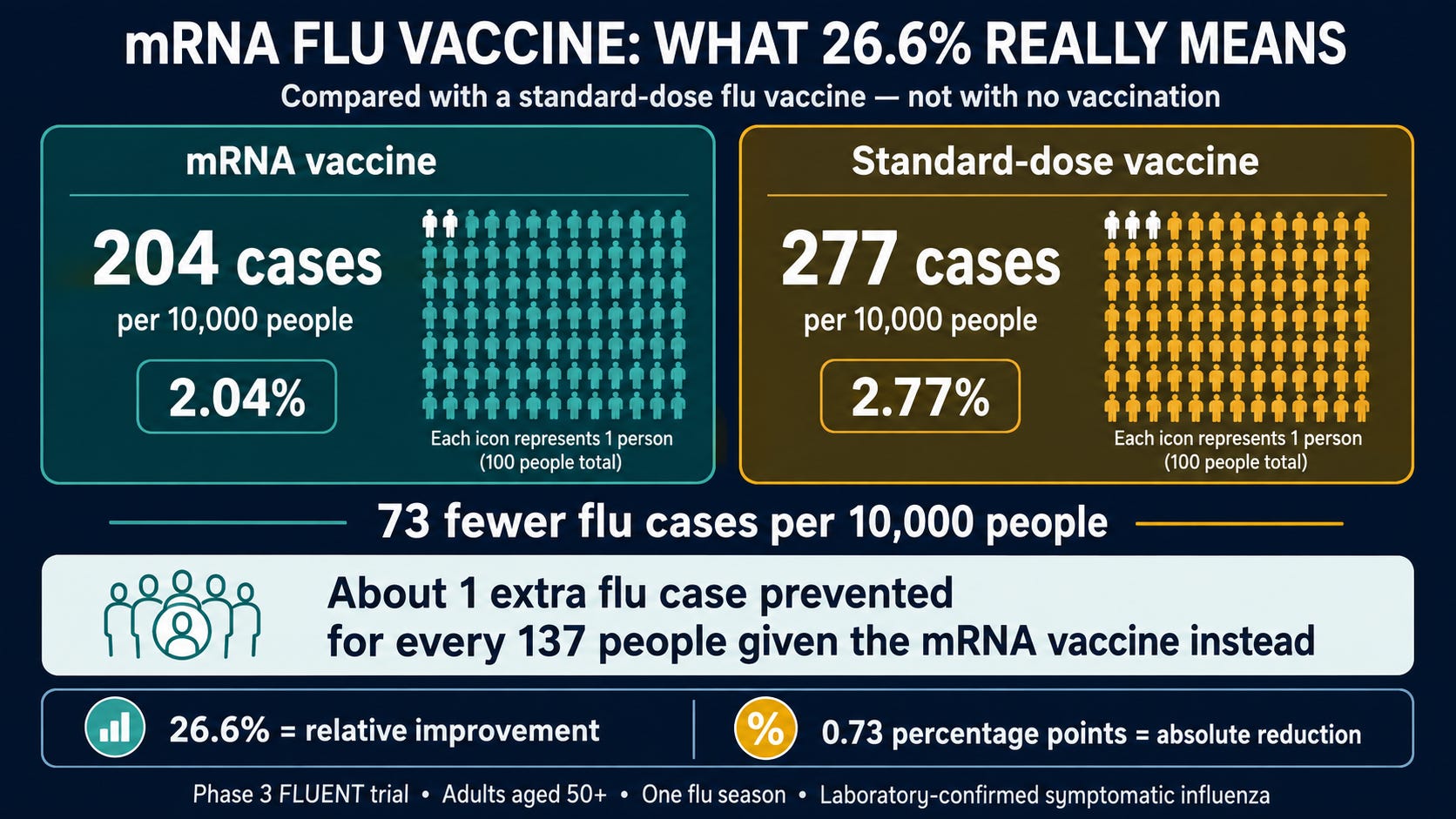
The headline result was a relative vaccine efficacy of 26.6% against laboratory-confirmed, protocol-defined influenza-like illness when mFLUSIVA was compared with a standard-dose influenza vaccine.
That sounds substantial. But relative efficacy is not the same as an absolute reduction in risk.
In the pivotal trial, 411 of 20,179 participants in the mRNA group developed the primary influenza outcome, against 557 of 20,124 on the standard-dose vaccine. That is approximately 2.04% versus 2.77%, or 73 fewer cases per 10,000 people vaccinated - an absolute reduction of about 0.73 percentage points.
I therefore need to vaccinate approximately 137 people with mFLUSIVA instead of the standard-dose vaccine to prevent one additional laboratory-confirmed influenza illness during that season.
That is a genuine benefit and I should not dismiss it. But a relative figure of 26.6% should not be read as a 26.6-percentage-point reduction. The trial also had no placebo or unvaccinated group, so it cannot tell me the absolute effectiveness of mFLUSIVA compared with receiving no flu vaccine.
The Comparator Is the Central Problem
For adults aged 50 to 64, comparison with a standard-dose vaccine is clinically reasonable. The difficulty lies in the older group.
In the United States, adults aged 65 and over are preferentially offered high-dose, adjuvanted or recombinant influenza vaccines. Yet the pivotal efficacy trial compared mFLUSIVA with a standard-dose vaccine, including in older adults.
The study answered one question - is mFLUSIVA better than a standard-dose vaccine? - but not the one that matters for older adults: does it prevent more influenza, hospitalisation or death than the enhanced vaccines already recommended for them?
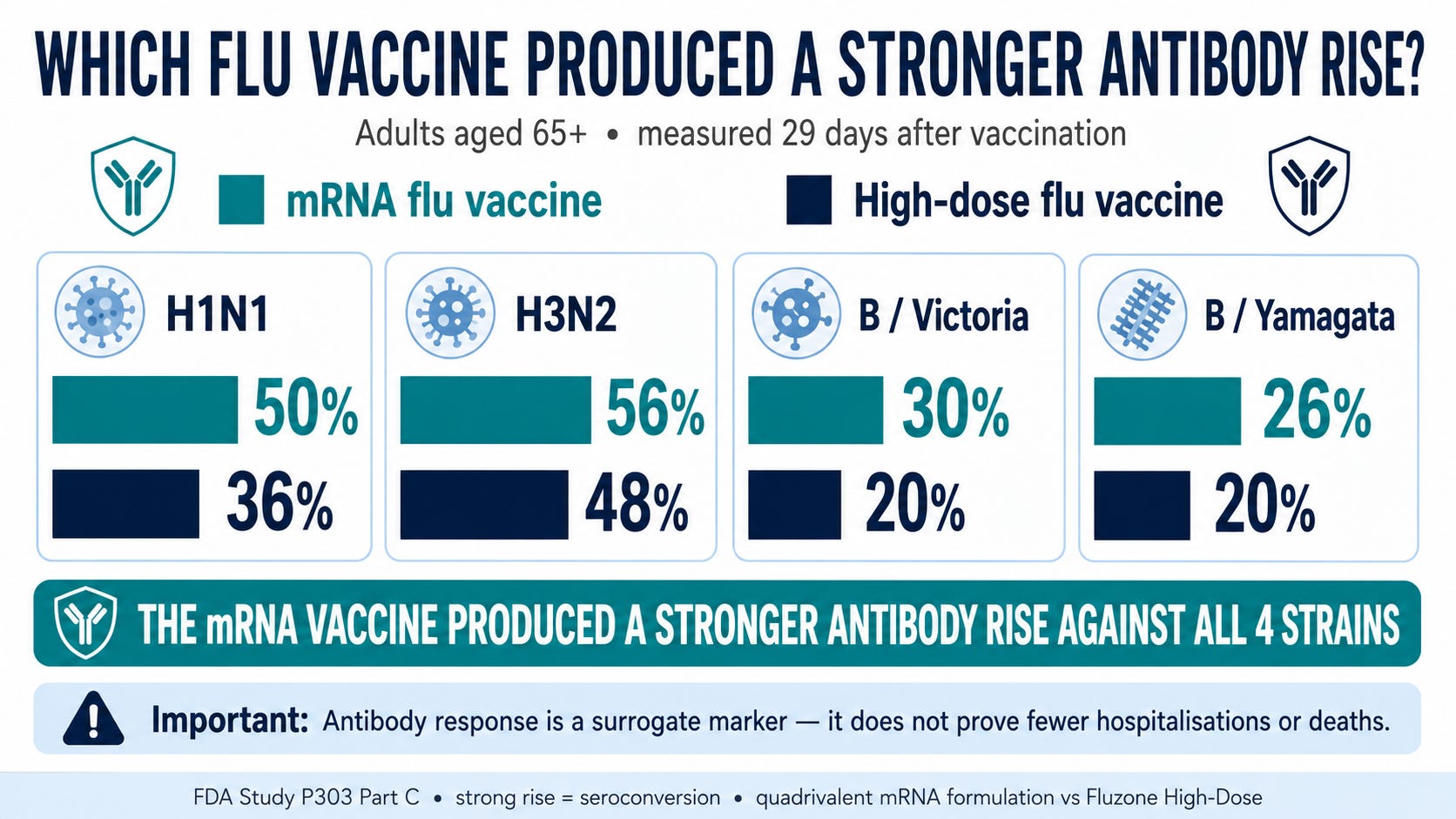
A separate study did compare antibody responses with Fluzone High-Dose in adults aged 65 and over. The mRNA vaccine produced stronger haemagglutination-inhibition responses across the four strains studied. But that is an immunogenicity result, not a clinical outcome. Higher antibody measurements may predict benefit; they are not the same as fewer infections, admissions or deaths. The FDA acknowledged the distinction by granting accelerated approval for the 65-and-over group and requiring a confirmatory randomised study against high-dose vaccine.
The FDA also flagged a technical concern. Some assays used cell-derived viruses matched to the mRNA vaccine, while the high-dose comparator was egg-derived. That does not invalidate the immunogenicity result, but it could favour the mRNA product in parts of the comparison, particularly for H3N2.
I therefore cannot honestly say that mFLUSIVA is clinically superior to the best existing options for older adults. That remains unproven.
More Immune Response, More Reactions
The stronger immune response came with substantially greater short-term reactogenicity.
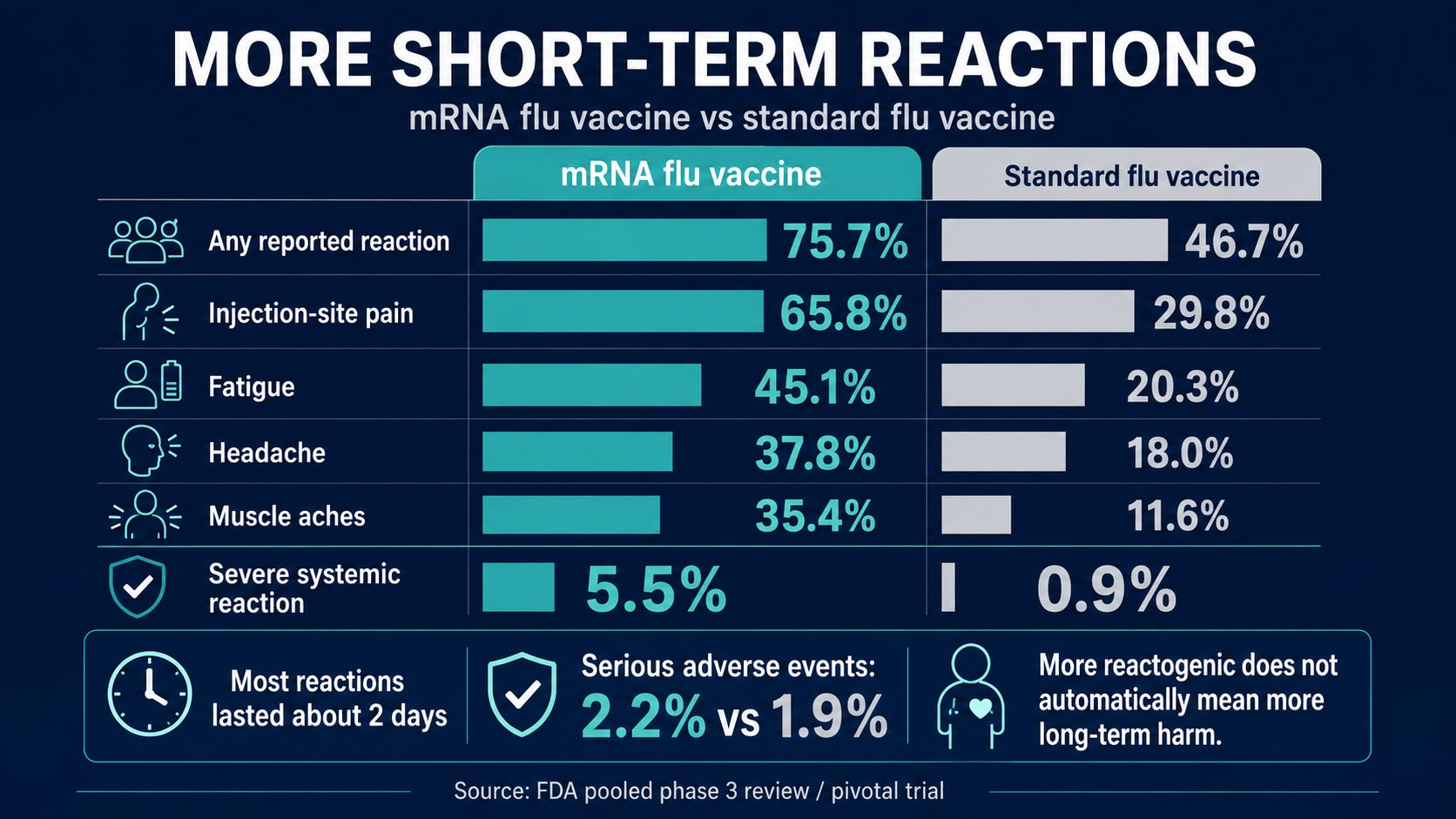
Any solicited reaction occurred in 75.7% of mRNA recipients compared with 46.7% of standard-vaccine recipients. Injection-site pain occurred in 65.8% versus 29.8%, fatigue in 45.1% versus 20.3%, headache in 37.8% versus 18.0%, and muscle pain in 35.4% versus 11.6%.
The clearest difference was in grade 3 systemic reactions: 5.5% with mFLUSIVA against 0.9% with the standard vaccine. These were activity-limiting reactions, not serious adverse events - roughly one additional such reaction for every 22 people vaccinated with the mRNA product.
Most reactions lasted about two days and were judged mild or moderate. Serious adverse events were much closer - 2.2% versus 1.9% in the pivotal trial - and the available data did not establish a major safety signal.
I need to be precise here. Greater reactogenicity does not prove lasting injury, nor by itself that the dose was too high. But it is a real biological and practical cost. If the absolute clinical gain is modest, tolerability becomes part of the benefit-risk calculation, particularly for a vaccine given every year.
The Mortality Finding Should Not Be Overstated - or Ignored
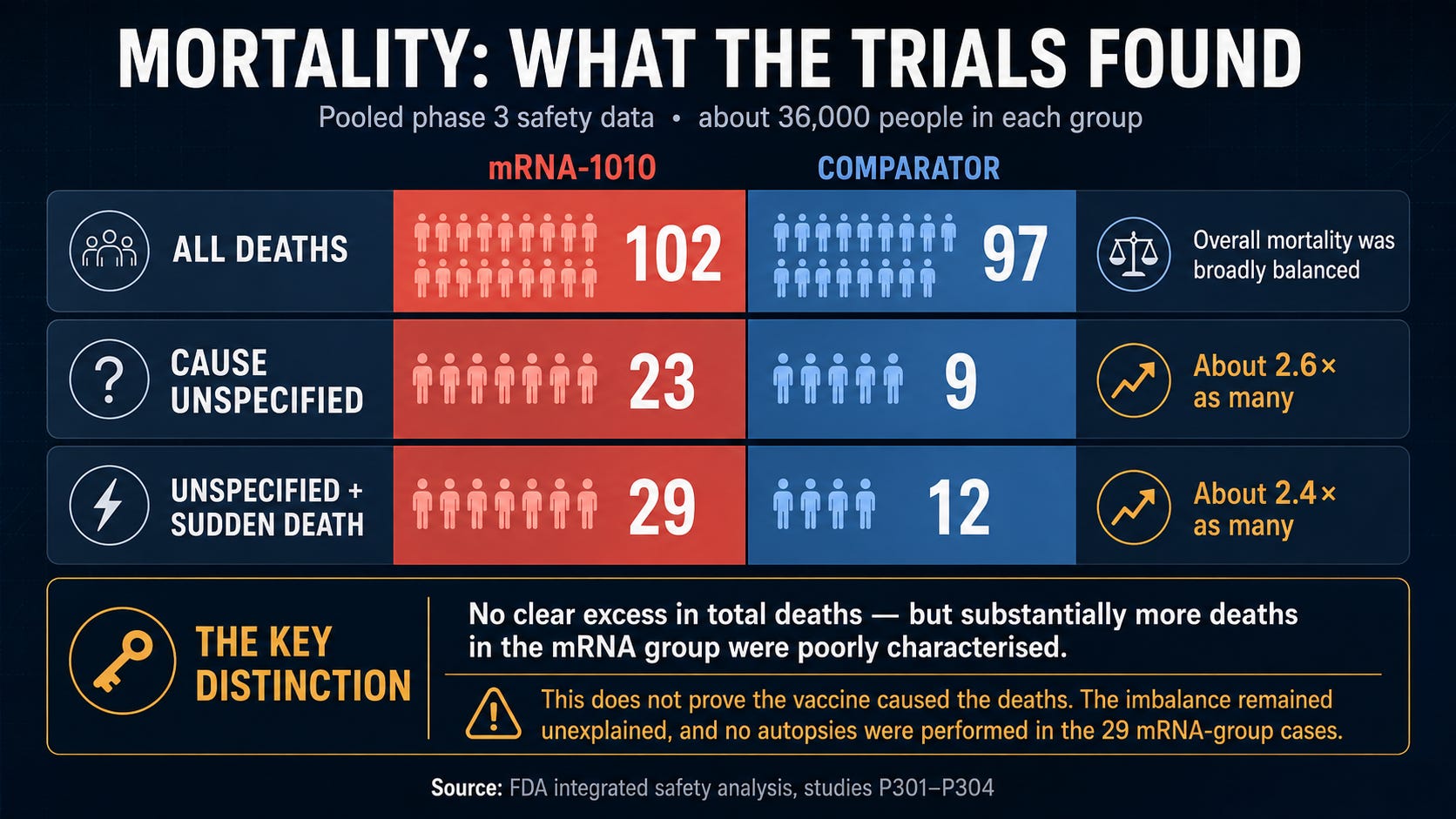
The pooled phase 3 safety programme included approximately 36,000 participants in each group. Overall mortality was broadly balanced: 102 deaths after mRNA-1010 and 97 after the standard- or high-dose comparators.
That does not show excess all-cause mortality.
But within those totals, the FDA identified 23 deaths coded as “death - unspecified” in the mRNA group against nine in the comparator group. Combining unspecified death, sudden death and sudden cardiac death, the figures were 29 versus 12.
These are classifications within the total, not additional deaths. The excess in poorly characterised deaths was offset by more specifically classified deaths in the comparator arm, so uneven documentation or coding is a plausible explanation.
The FDA noted that most occurred months after vaccination, outside the expected acute risk period, and generally involved older participants with substantial cardiovascular and metabolic disease. On that basis it judged causality unlikely and did not treat the imbalance as a safety signal.
That reasoning is defensible. It is not the same as an explanation.
No autopsies were performed in the 29 mRNA-group deaths in the broader unspecified grouping. Without pathological evidence, I cannot say whether the difference arose from chance, inconsistent ascertainment, undiagnosed cardiovascular disease or another mechanism.
I should not present these numbers as proof that the vaccine caused deaths; the data do not support that. But nor should I pretend that an unexplained, statistically notable coding imbalance has been resolved because overall mortality was similar.
The Lipid-Nanoparticle Question Needs Precision
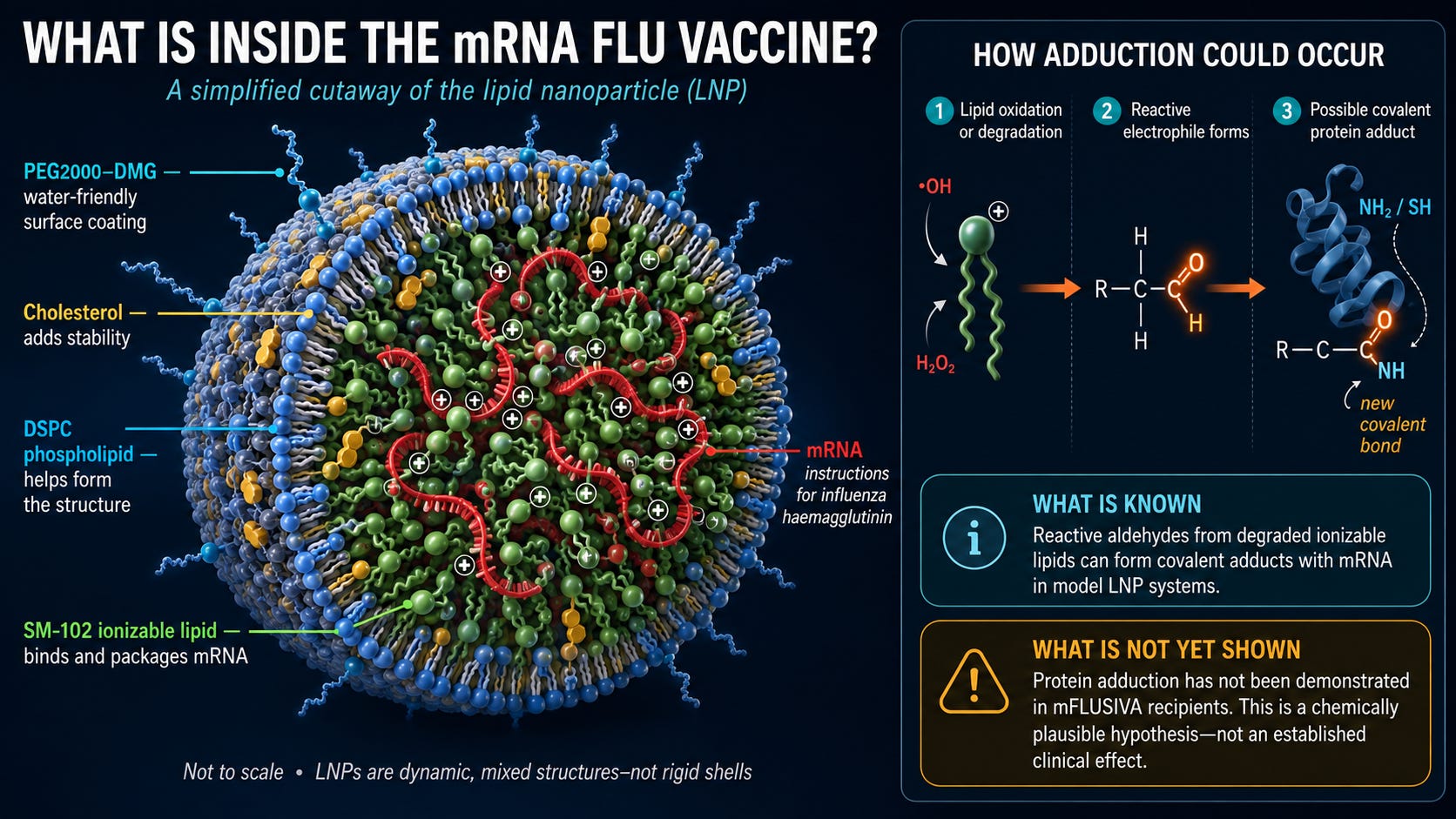
mFLUSIVA uses mRNA packaged in lipid nanoparticles containing the ionisable lipid SM-102, cholesterol, DSPC phospholipid and a PEG-lipid. The particle protects the mRNA and delivers it into cells, where the encoded influenza antigens are produced.
There is a legitimate formulation-science question here, but it is frequently described inaccurately.
Laboratory studies have shown that degradation products from some ionisable lipids can generate reactive aldehydes that form covalent adducts with mRNA, reducing transcript integrity and protein expression. More recent work has reinforced the importance of lipid oxidation, raw-material purity and analytical controls.
What has not been demonstrated is that mFLUSIVA causes clinically important protein adduction in recipients, or that this produces cancer or autoimmune disease. Adduction by reactive electrophiles is chemically plausible in general, but moving from plausibility to a claim of clinical harm would outrun the evidence.
The proper question is not whether I can declare that adduction has harmed people. I cannot. It is whether product-specific controls adequately characterise lipid degradation products, mRNA adduct formation and stability across manufacturing, storage and repeated annual use. That is a quality and surveillance question worth asking directly.
The Price Changes the Burden of Proof
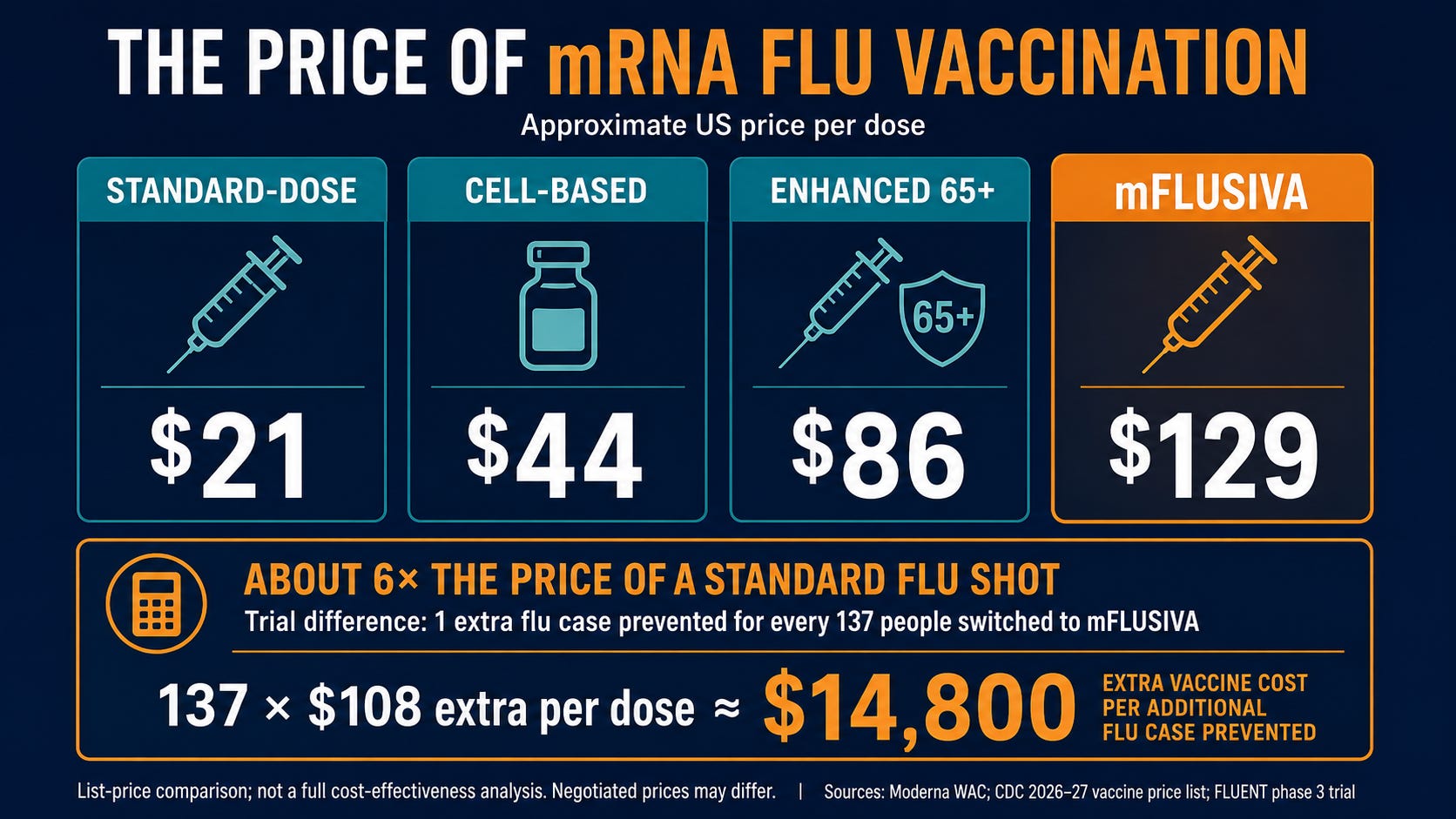
The published US wholesale acquisition cost for mFLUSIVA is approximately $129 per dose. Private-sector list prices for the 2026-27 season are about $21 for several standard-dose vaccines, $44 for a cell-based vaccine, and $86 for high-dose, adjuvanted or recombinant options.
Against the standard-dose vaccine used in the efficacy trial, that is an incremental acquisition cost of roughly $108 per person. Multiplied by the number needed to vaccinate - about 137 - that is approximately $14,800 in additional vaccine spending for each extra laboratory-confirmed influenza illness prevented during the trial season.
That is not a full cost-effectiveness analysis. It excludes negotiated discounts, avoided consultations, time off work, admissions and the value of preventing a severe outcome. But the trial established no mortality benefit, and the more serious healthcare outcomes were too infrequent to carry an economic case on their own.
For adults over 65 the problem is sharper. The vaccine costs about $43 more than enhanced alternatives, yet clinical superiority over them has not been demonstrated.
Moderna plainly has a commercial incentive to extend its mRNA platform beyond COVID-19. That deserves scrutiny, but it is not evidence that the FDA approved the vaccine to protect the company or the wider industry. I do not need to speculate about regulatory motive to see the stronger problem: a premium price is being asked before comparative clinical superiority in older adults has been established.
When a product asks a health system to pay more, tolerate more short-term reactions and accept greater long-term uncertainty, I believe the evidential burden should rise, not fall.
What the Approval Does - and Does Not - Establish
The FDA has required a confirmatory high-dose comparison in older adults, plus post-authorisation active surveillance covering deaths, myocarditis, pericarditis, myopericarditis and Guillain-Barre syndrome. Those commitments matter. They also show what remains unfinished at the point of approval.
Previous use of the mRNA platform did not let mFLUSIVA bypass clinical testing. It underwent large randomised trials and an FDA advisory review. Platform familiarity can inform regulation, but it cannot substitute for product-specific evidence about the comparator that matters, repeated annual dosing or long-term safety.
I do not think the evidence justifies calling mFLUSIVA a failure. It is a genuine proof of efficacy for an mRNA influenza platform, and it may eventually offer advantages through faster strain updating or better protection in particular seasons.
But neither do I think it should be presented as the obvious successor to conventional influenza vaccination.
What the evidence shows is a modest absolute reduction in laboratory-confirmed illness against a standard-dose vaccine, greater short-term reactogenicity, an unresolved imbalance in poorly characterised deaths, unanswered formulation questions and a substantial price premium. In the group at greatest risk - adults aged 65 and over - the clinically relevant comparison has not been done.
My concern is not that a new technology has been approved. Innovation is necessary.
Nor can I claim from this approval that conventional flu vaccines are destined to disappear. That is a commercial forecast, not a scientific finding.
My concern is that proof a product works can quietly become an assumption that it is better, represents good value and should replace established alternatives. Those are separate claims, each requiring separate evidence.
For mFLUSIVA, the first has been demonstrated.
The others have not.
Selected Source Material
FDA Vaccines and Related Biological Products Advisory Committee briefing document for mFLUSIVA, 18 June 2026: Open source
FDA approval letter for mFLUSIVA, 5 August 2026: Open source
Leroux-Roels I, et al. Efficacy and Safety of an mRNA Seasonal Influenza Vaccine in Adults. New England Journal of Medicine. 2026. Open source
FDA prescribing information and recipient information for mFLUSIVA: Open source 1 and Open source 2
CDC Adult Influenza Vaccine Price List, 2026-27 season: Open source
Moderna wholesale acquisition cost disclosure: Open source
Packer M, et al. A novel mechanism for the loss of mRNA activity in lipid nanoparticle delivery systems. Nature Communications. 2021;12:6777. Open source
Kang RS, et al. Spotlighting the criticality of lipid quality control through a mechanistic investigation of mRNA activity loss in lipid nanoparticles. Communications Chemistry. 2025. Open source


