

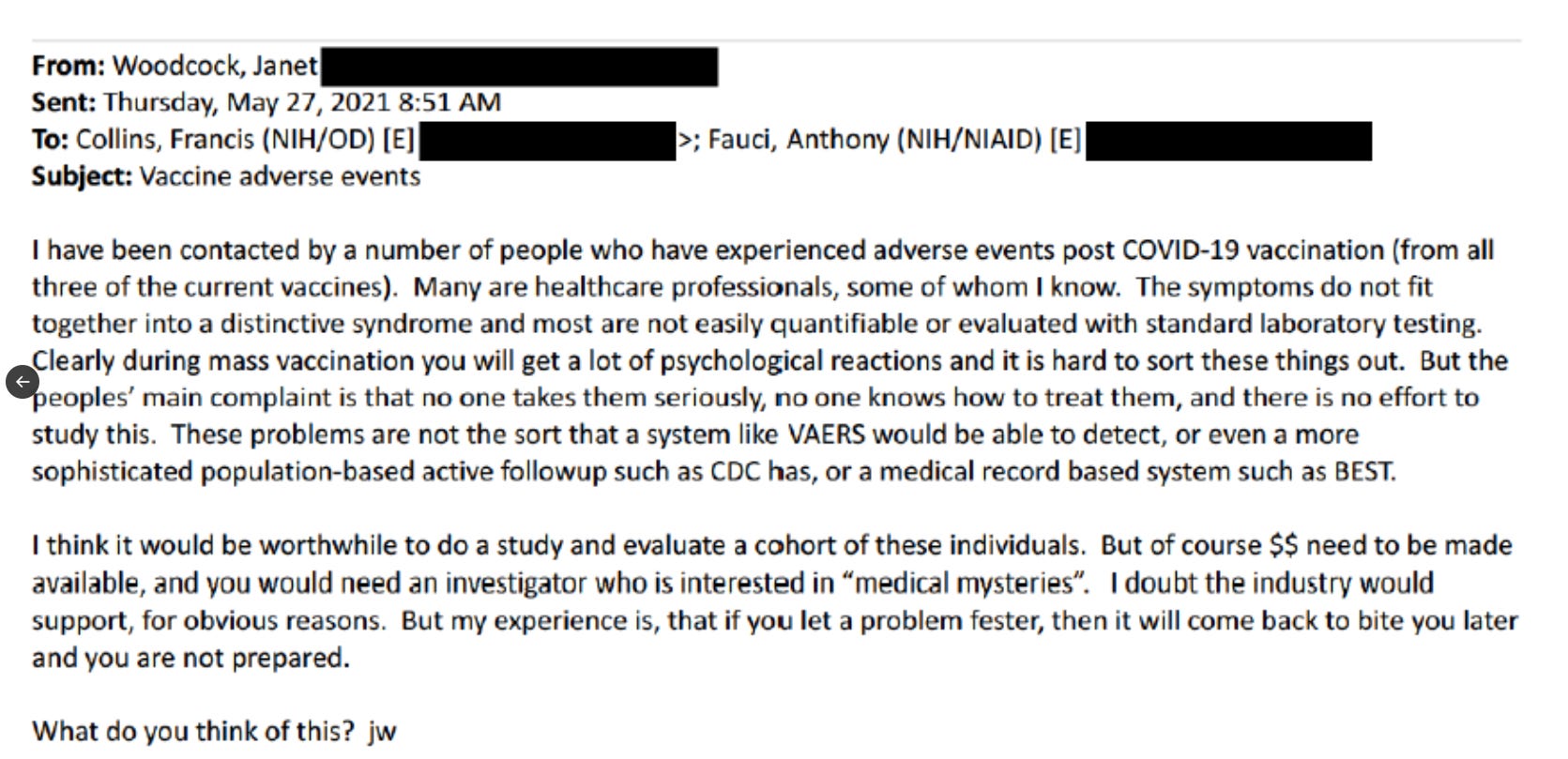
On 27 May 2021, Janet Woodcock emailed Francis Collins and Anthony Fauci. The subject line was “Vaccine adverse events.” She was not simply a senior FDA official at the time. She was the Acting Commissioner.
She wrote that a number of people had contacted her after COVID-19 vaccination, including healthcare professionals whom she knew. The reports came after all three vaccines then in use in the United States. The symptoms did not form one neat syndrome and were often difficult to measure using routine laboratory tests.
The most important part was not a claim about mechanism. It was her description of what these people were saying: they were not being taken seriously, clinicians did not know how to treat them and there was no organised effort to study them.
Woodcock then made a more uncomfortable observation. She believed that neither VAERS, population surveillance nor medical record based systems were well suited to detect this type of problem. She proposed a dedicated cohort study and warned that allowing the problem to fester would leave the system unprepared later.
“Behind the scenes, they knew something wasn’t right.”
What the Document Actually Establishes
I need to be exact here, because the document is powerful enough without exaggeration.
It establishes that the Acting FDA Commissioner had personally received reports of difficult to classify symptoms after vaccination.
It establishes that she regarded those reports as worthy of a structured clinical study.
It establishes that she questioned whether existing safety systems could identify the pattern.
It establishes that senior figures at the NIH and NIAID were made aware of her concern.
It does not establish how many people were affected. It does not prove that vaccination caused every reported symptom. It does not identify a biological mechanism. It does not show what Collins or Fauci did after receiving it. It does not, by itself, prove a deliberate cover up.
Those distinctions matter. If I turn the email into evidence that it is not, I make it easier for the central fact to be dismissed. The central fact is that a senior regulator identified a plausible safety surveillance gap during the first year of the vaccine rollout and explicitly asked whether a cohort should be studied.
The Surveillance Blind Spot Was the Real Warning
VAERS is an early warning system, and a useful one for detecting unusual reporting patterns. But it is passive. Someone must recognise an event and submit a report. It is particularly vulnerable when symptoms are non specific, laboratory tests are normal and no clinician assigns a clear diagnosis.
That is exactly the phenotype Woodcock was describing. A person may have disabling fatigue, cognitive disturbance, headache, dysautonomia, altered exertional tolerance or fluctuating inflammatory symptoms without being admitted to hospital or receiving a diagnostic code that triggers surveillance. If the illness does not fit an expected category, the absence of a signal can reflect the limits of the system rather than the absence of a problem.
Active systems based on electronic health records can do more, but they depend on what is recorded. If clinicians do not recognise the syndrome, if patients are reassured without follow up, if symptoms are divided across several specialties, the record becomes fragmented. A database cannot discover a coherent phenotype that clinical practice has never defined.
“These patients were falling into a gap that nobody seemed willing to address.”
Why Reports Across Three Vaccines Matter
The reference to all three vaccines is scientifically interesting, but it is not a conclusion.
The products did not share a delivery platform. Two used messenger RNA and one used an adenoviral vector. What they shared was the target: the SARS-CoV-2 spike protein. That makes a spike related immune mechanism a reasonable hypothesis, particularly when some patients describe symptoms resembling infection associated post viral illness.
But a shared antigen does not prove that the antigen caused the syndrome. Similar symptoms could arise through different mechanisms, background illness, prior unrecognised infection, immune activation that is not specific to spike, or reporting artefact. The email gives me a research question, not permission to skip the research.
My own work has increasingly focused on whether spike exposure, from infection, vaccination or both, can leave a vulnerable subgroup with persistent immune activation. I am particularly interested in people who may have pre existing inflammatory susceptibility and impaired clearance of antigenic fragments. This remains a mechanistic framework under investigation. It should be tested against competing explanations rather than treated as settled fact.
Long COVID Complicates the Picture
Long COVID clearly existed before vaccination. Some people became ill after infection in early 2020 and have remained unwell. Any account that erases them is simply wrong.
The harder question is whether a clinically overlapping syndrome can follow vaccination in a smaller subgroup, and whether infection and vaccination can interact in the same person. That overlap is precisely why crude datasets struggle. Severe organ damage after acute COVID, post viral immune disease, dysautonomia, post exertional symptom exacerbation and symptoms beginning after vaccination may all be grouped together despite different initiating pathways.
If I want clarity, I need phenotyping. I need timelines. I need documented infection status where possible. I need vaccine exposure, symptom onset, prior inflammatory history, objective autonomic and immunological measures and appropriate comparison groups. Without that structure, every side can select the subgroup that supports its preferred narrative.
“Long COVID existed before the vaccines. Some people developed it from infection alone and are still struggling today.”
The Funding Sentence Matters
Woodcock wrote that money would have to be made available and that an investigator interested in medical mysteries would be needed. She also doubted that industry would support the work.
I should not convert that into proof that commercial interests stopped the study. The email cannot establish that. But it identifies a predictable incentive problem. A manufacturer has little commercial reason to search aggressively for a difficult, heterogeneous syndrome that could be associated with its product. That is exactly why independent public funding and regulatory leadership exist.
The conflict becomes sharper when policy moves faster than the investigation. The email was written in May 2021. In September 2021, the United States announced federal vaccination requirements for employees and contractors, with additional workplace and healthcare requirements following later that year. A policy can still have been justified by the evidence available at the time, but coercive policy raises the standard of safety investigation. It does not lower it.
The People Caught in the Gap
The most damaging failure is not statistical. It is clinical.
People with complex symptoms often discover that medicine becomes least curious when routine tests are normal. They are passed between specialties, told that nothing serious has been found and left without a coherent explanation. Some were already experiencing this after infection. Others believed their symptoms began after vaccination. The political argument made both groups harder to treat, because clinicians were pushed toward choosing a side rather than investigating a patient.
I do not need to accept every causal claim in order to take the patient seriously. Taking someone seriously means documenting the sequence carefully, examining plausible mechanisms, considering alternatives and acknowledging uncertainty. Dismissal is not scientific scepticism. It is the abandonment of scientific method at the point where the case becomes difficult.
“The symptoms were not specific enough to produce a clear diagnosis, so they remained hidden from almost every monitoring system.”
What Should Have Happened
The study Woodcock proposed should have begun immediately. It should have recruited patients prospectively, separated infection only, vaccination only and combined exposure groups, and included matched controls. It should have used standardised symptom phenotyping, autonomic testing, exercise response, immune profiling, virological assessment and longitudinal follow up.
It should also have been independent enough to produce an uncomfortable result. A study designed only to reassure is not surveillance. A study designed only to confirm injury is not surveillance either. The purpose is to determine who became ill, after which exposure, through what mechanism, at what frequency and with what prognosis.
That work would not have answered every question, but it would have produced a clinical map. Instead, years were lost while patients and institutions argued over whether the syndrome was even permissible to discuss.
Additionally, it should have stopped vaccine mandates in lower risk cohorts who were hesitant to get a Covid vaccine.
“There are too many people who will lose money if they look seriously at the science.”
The Warning at the End
Woodcock ended with a sentence that now carries more weight than it did in 2021. If a problem is allowed to fester, she warned, it will return later when the system is unprepared.
I think that is the real story in this email.
It is not proof of every claim made about COVID vaccination. It is proof that uncertainty was recognised at the highest level, and that the correct scientific response was obvious: define the cohort, study the pattern, prepare clinicians.
The public argument has spent too much time demanding a choice between infection injury and vaccine injury. Biology does not respect that political division. If spike associated immune pathology can arise through more than one exposure pathway, then the source matters clinically, but the downstream patient still needs the same seriousness, the same curiosity and the same commitment to treatment.
The question is no longer whether the warning existed.
It did.
The question is why the cohort Woodcock described was not made impossible to ignore.
Vejon COVID-19 Review is reader-supported. No advertisers, no institutional funding, no obligation to reach a particular conclusion. Subscribe free for new posts, or paid to support the work directly.
Sources
Primary document. Janet Woodcock email to Francis Collins and Anthony Fauci, 27 May 2021 (source image supplied with the transcript)
Safety surveillance. CDC overview of VAERS, including its purpose, strengths and limitations
Active monitoring. CDC overview of the Vaccine Safety Datalink
Federal employees. Executive Order 14043 of 9 September 2021
Federal contractors. Executive Order 14042 of 9 September 2021
Senate report. Permanent Subcommittee on Investigations majority staff interim report, 29 April 2026


