

I keep returning to one uncomfortable question. If an infection feels mild for three or four days, has it left the person biologically unchanged?
I do not think we can assume so. The acute illness is only the part we see. The harder question is whether repeated infections leave a proportion of people with persistent antigen, altered immune regulation, endothelial stress, abnormal clotting or an inflammatory state that never quite returns to baseline.
That question shaped my follow-up discussion with Dr Shankara Chetty and Joachim Gerlach (timecodes below). Joachim came to it through laboratory observations involving spike protein, Shankara through patterns in clinical practice. I came from the hospital side, where patients arrive with recognised syndromes such as fatigue, transient neurological symptoms or vascular events, but with no framework connecting them to a recent infection.
The discussion produced important signals. It also produced claims that need restraint. Preliminary laboratory data can generate a hypothesis; they cannot establish population prevalence or prove a treatment. Clinical experience can reveal patterns worth studying; it cannot replace controlled evidence. If we blur those distinctions, we weaken the very argument we are trying to advance.
Mild Acute Disease Is the Wrong Endpoint
The public has largely been taught to judge COVID by hospital admission, oxygen requirement and intensive care. By those measures, the current disease often looks milder than the first waves. That is reassuring for acute mortality. It does not answer the post-acute question.
A person can recover from the fever, cough and sore throat and still develop fatigue, cognitive difficulty, autonomic symptoms, exercise intolerance or vascular complications later. Not everyone will, and most infections do not produce catastrophic disease. The mistake is leaping from that fact to the far broader conclusion that reinfection is harmless.
Large observational studies have reported that additional infections can add further post-acute risk. The best-known analysis, in United States veterans, found graded increases in death, hospitalisation and multisystem sequelae with reinfection. Its predominantly older male population limits how precisely the numbers apply to everyone else. It nevertheless challenges the idea that each exposure simply resets the risk to zero.
What The Spike Tests Actually Show
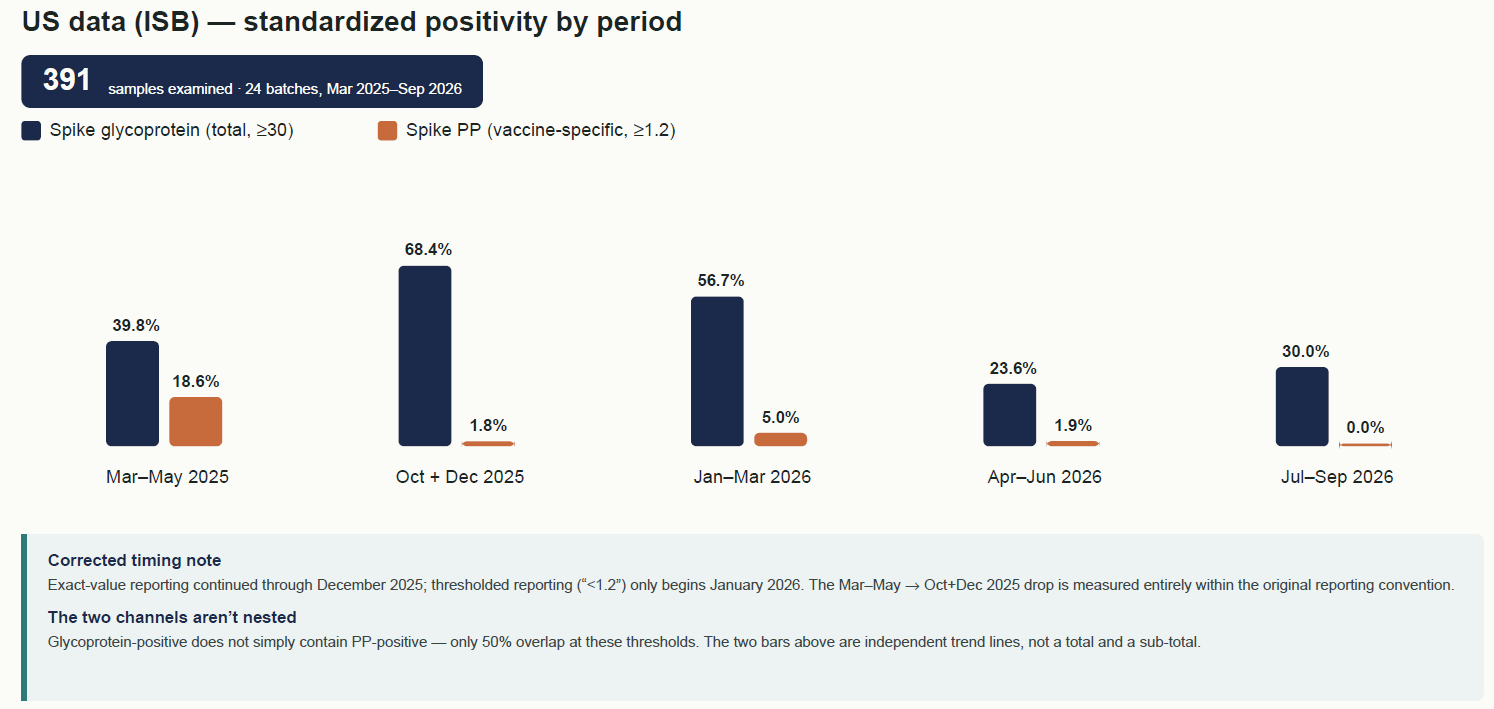
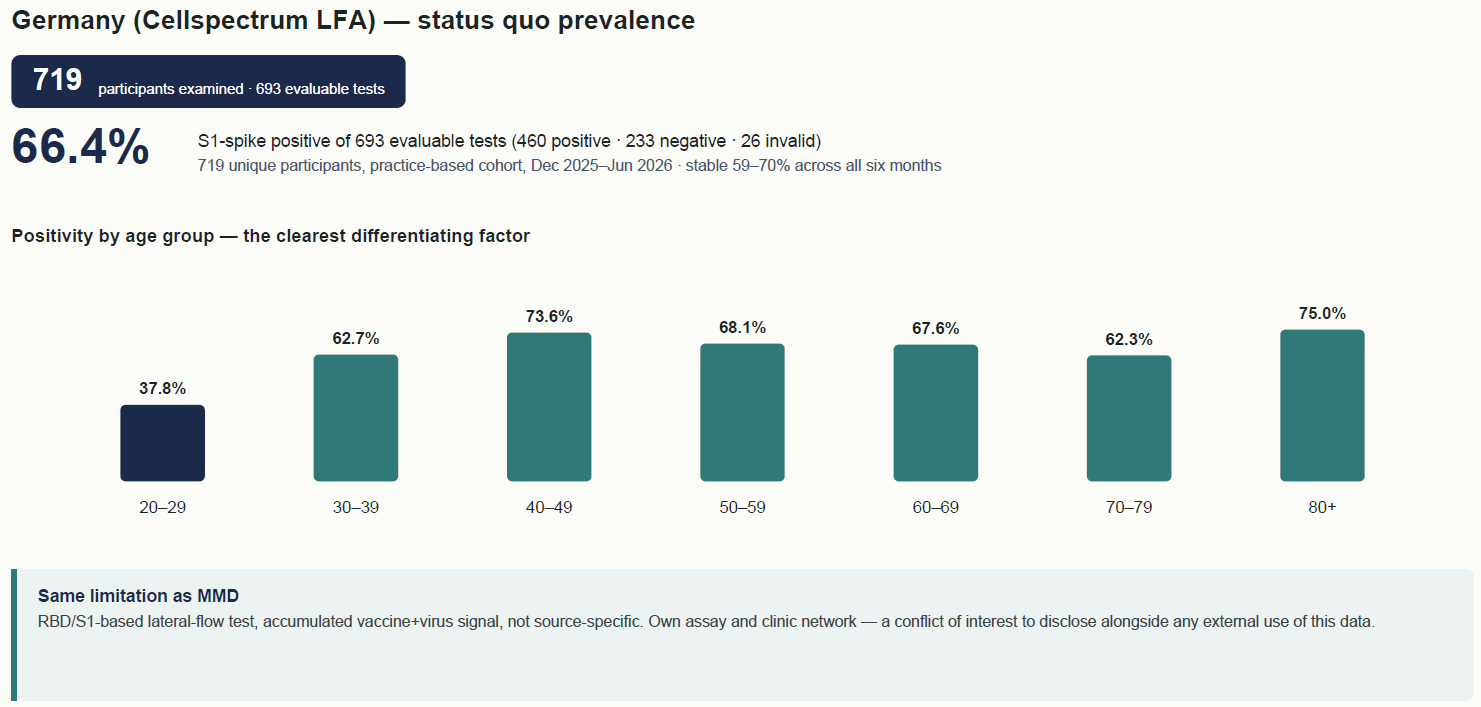
Joachim presented three streams of testing: mass-spectrometry work from the United States, laboratory testing from Germany and a finger-prick screening programme involving several hundred participants. He described spike-positive findings in plasma, extracellular vesicles and peripheral blood immune-cell fractions.
Those observations are potentially important, but the denominator matters. These were not random population samples. Many participants sought testing because they were unwell, concerned or already attending a practitioner. A positivity rate from that setting cannot be translated into the percentage of the general public carrying circulating spike protein.
The assays also need independent validation across laboratories: clearly defined detection thresholds, blinded controls, pre-pandemic samples, repeat testing, information on recent infection and vaccination, and agreement on what each method is measuring. Without that, a change from one year to the next could reflect biology, selection, assay behaviour or simply a different type of patient being tested.
None of this makes the findings irrelevant. It defines what they are: an early clinical signal that deserves a properly designed population study.
Persistent Antigen Is No Longer A Fringe Question
The wider scientific literature now supports the possibility that SARS-CoV-2 material can persist after an apparently mild infection in at least a subset of people. Studies have detected viral antigens in plasma months after infection, viral RNA or protein in tissue, and S1 protein within non-classical monocytes. Other work has linked tissue persistence with long COVID symptoms, although association does not prove that persistence is the sole cause.
That distinction is essential. Detecting spike protein does not automatically prove that intact virus is replicating. It does not identify the tissue producing the signal. It does not tell me whether the antigen is driving disease, reflecting impaired clearance or simply accompanying another process.
The correct conclusion is narrower, but still significant. Persistent antigen is biologically plausible, repeatedly observed and relevant enough to investigate as one possible driver of post-COVID disease. It should be neither dismissed nor promoted as a complete explanation for every patient.
Exosomes And Immune Cells
The most provocative part of the discussion concerned extracellular vesicles, including exosomes. Cells use these small packages to move proteins, lipids and genetic material. Viral proteins can appear within them, and the vesicles themselves can influence immune signalling.
Joachim’s data reportedly showed more spike-positive extracellular-vesicle samples in 2026 than in the earlier comparison period. I suggested that long-lived immune cells could be involved, because monocytes and macrophages can retain viral material and exchange signals through extracellular vesicles.
That remains a hypothesis. Spike-positive vesicles do not by themselves prove productive infection of immune cells, nor that those cells are manufacturing infectious virus. Resolving this would require paired measurements of protein, viral RNA, replication intermediates, cell phenotype and functional activity. The mechanism is testable. The figures presented in this discussion have not yet demonstrated it.
Why The Same Exposure Produces Different Outcomes
Shankara used the analogy of a bee sting. The exposure may be similar, but the response depends on the person. I think that captures an important principle, provided we do not reduce every case to allergy.
The spike protein may act as a trigger, but the cascade that follows depends on the terrain it enters. Endothelial health, metabolic disease, previous immune activation, autoimmune susceptibility, microbiome disruption, latent infections, age and the capacity to clear antigen may all alter the response. My own way of describing this is the ember model. An exposure can land on a quiet system and resolve, or land on an existing focus of inflammation and amplify it.
This helps explain why one patient has a brief illness while another develops months of fatigue, post-exertional worsening, dysautonomia or cognitive symptoms. It also explains why risk cannot be inferred from how mild the first few days appeared.
Women have a higher measured risk of long COVID in several cohorts, particularly through parts of midlife. That deserves investigation through immune regulation, hormonal state, pregnancy and menopause, autoimmune susceptibility and exposure patterns. It should not be reduced to the unsupported claim that women simply have weaker immune systems.
Now available on Amazon - Help us Get to #1

Amazon purchase link here >
Fatigue May Be An Early Clinical Signal
One of Shankara’s simplest clinical observations was also one of the most useful. A person wakes at eight in the morning and, by ten, feels compelled to lie down. That is not ordinary tiredness after a demanding day.
Fatigue is non-specific. It cannot diagnose persistent spike, microclots or immune dysregulation, and anaemia, thyroid disease, sleep apnoea, medication effects, depression, cardiac disease and many other conditions must still be considered. But a sudden change in energy after infection deserves a proper chronology, not dismissal because routine blood tests are normal.
The same applies when symptoms cross systems. Fatigue, palpitations, gastrointestinal disturbance, cognitive difficulty and exercise intolerance can look unrelated when each is assessed in isolation. Their timing after infection may reveal that they belong to one post-infectious process, even when the precise mechanism differs between patients.
The Microvascular Question
The discussion then turned to abnormal clotting. Research groups have described fibrin amyloid deposits, platelet activation and impaired fibrinolysis in long COVID cohorts. Standardisation, prevalence and clinical application remain debated, but the vascular question cannot simply be ignored.
Shankara described a relative with recurrent episodes of confusion, impaired hand-eye coordination and facial weakness. The case involved severe carotid disease, transient neurological deficits and changes in antithrombotic treatment. It was clinically striking, but it cannot prove that microclots caused the episodes or that anticoagulation was responsible for recovery. Severe carotid stenosis alone provides a recognised mechanism for recurrent transient ischaemia.
This is where clinical urgency and evidential discipline can collide. We need studies that identify which post-COVID patients have measurable coagulation abnormalities, whether those abnormalities predict events and whether targeted treatment improves outcomes without unacceptable bleeding. Until then, anticoagulation should not be generalised from an anecdote. Current stroke and TIA guidance still bases anticoagulation on established indications such as atrial fibrillation or another recognised cardioembolic source, while antiplatelet therapy is generally used for non-cardioembolic disease.
The Hospital Blind Spot
Hospital medicine is organised around recognised diagnoses. That structure is necessary, but it creates a blind spot when a disease process crosses specialties. A patient may have normal routine blood tests, no atrial fibrillation and no large new infarct, yet still be experiencing a genuine post-infectious deterioration.
The answer is not to assign every unexplained presentation to spike protein. It is to record infection chronology, define phenotypes, repeat measurements and look for patterns across neurology, cardiology, immunology, haematology and rehabilitation. If current laboratory panels cannot detect the proposed mechanism, that is a reason to develop and validate better tests, not a licence to infer the diagnosis without evidence.
Patients lose trust when medicine tells them that normal standard investigations mean nothing is wrong. Medicine loses credibility in the opposite direction when practitioners offer certainty from unvalidated tests. Both errors leave the patient exposed.
Treatment Claims Must Catch Up With The Evidence
Joachim and Shankara described an emerging sequence of care: reduce persistent antigen where possible, address coagulation abnormalities, stabilise immune dysregulation, rebuild the gut and support mitochondrial and neurological recovery. As a conceptual framework, that sequence is coherent.
It is not yet an established treatment pathway. Terms such as spike removal or detoxification need measurable definitions. A fall in an assay signal must be linked to reproducible clinical improvement, compared with controls and assessed for adverse effects.
The strongest next step is not to declare the problem solved. It is to standardise the tests, define patient subgroups and test interventions against meaningful outcomes. That is slower than making confident claims, but it is the only route that will persuade clinicians outside the existing network.
What Public Health Still Needs To Explain
Public messaging has remained trapped between two inadequate positions. One treats every infection as an emergency resembling 2020. The other treats the fall in acute severity as proof that continuing circulation has little biological consequence.
The evidence supports neither extreme. Most people will recover from an individual infection without severe lasting illness. A meaningful minority will not, and repeated infection appears capable of adding risk. Persistent viral material, immune dysregulation, endothelial injury, autonomic disturbance and abnormal clotting are active areas of research, not settled explanations for every case.
Public health should be able to communicate that uncertainty honestly. People do not need panic. They need to know that recovery should be judged by return to baseline, that new multisystem symptoms after infection deserve attention, and that avoiding unnecessary reinfection remains rational even when hospital pressure is low.
The Question Is No Longer Whether COVID Is Mild
I came away from this discussion convinced that the word mild is doing too much work. It describes the visible acute episode. It says little about antigen clearance, vascular stress, immune recovery or what the next infection will do.
Joachim’s preliminary spike data cannot tell us how much of the population is affected. Shankara’s clinical cases can give guidance for prevalence and treatment strategies. My own hospital observations cannot prove a unifying mechanism. Together, however, they define a coherent research question that should no longer be neglected.
What happens when repeated exposure meets a person who has not fully returned to baseline?
That is the question I believe clinicians, researchers and public-health agencies now need to answer. If we wait until the resulting disability is obvious in every dataset, we will have recognised the problem at the point when it is hardest to reverse.
Video Chapters
00:00 Introduction and three clinical perspectives
03:17 What spike protein testing is reporting
06:00 Viral and vaccine derived spike signals
11:55 Why clinic samples are not population surveys
13:03 Clinical patterns after repeated infection
15:10 Using spike testing as a diagnostic clue
17:25 Scientific resistance and the problem of causation
22:00 German spike positive trends in 2025 and 2026
24:05 Exosomes and the immune cell hypothesis
26:00 Why individual susceptibility differs
32:00 Age symptoms and vaccination status
37:00 Six converging vulnerability pathways
43:20 Macrophages microclots and inflammatory embers
45:00 A recurrent neurological case and its limitations
55:52 Women autoimmunity and immune development
1:03:20 Recovery strategies research needs and closing thoughts
Selected Evidence
Peluso and colleagues reported excess SARS-CoV-2 antigen detection in plasma up to 14 months after acute infection: Plasma based antigen persistence in the post acute phase of COVID 19.
Zuo and colleagues examined residual SARS-CoV-2 in tissues after mild infection and its association with long COVID symptoms: The persistence of SARS CoV 2 in tissues and its association with long COVID symptoms.
Bowe and colleagues reported graded cumulative risk after reinfection in a United States veterans cohort: Acute and postacute sequelae associated with SARS CoV 2 reinfection.
The RECOVER Adult cohort found a higher adjusted risk of long COVID among women, with important variation by age and reproductive stage: Sex Differences in Long COVID.
Pretorius and colleagues described fibrin amyloid deposits and platelet pathology in a selected long COVID cohort: Prevalence of symptoms comorbidities fibrin amyloid microclots and platelet pathology.
Current United Kingdom recommendations for acute stroke and TIA management are available from NICE: Stroke and transient ischaemic attack in over 16s.


