

Another cardiovascular drug has failed. My first question is not whether the molecule was ineffective, but whether the trial tested the right disease.
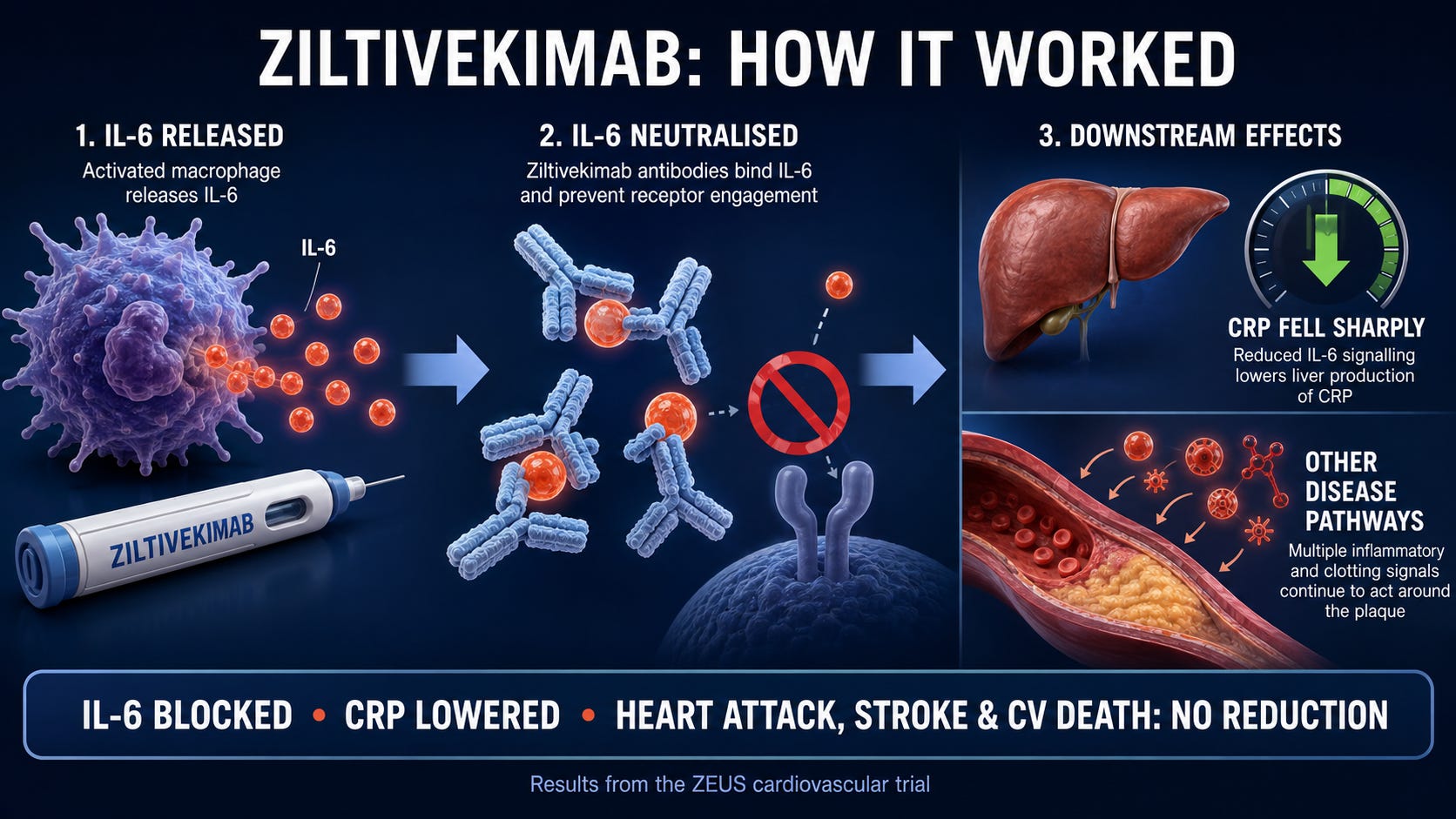
Novo Nordisk’s phase III ZEUS trial enrolled 6,376 people with established atherosclerotic cardiovascular disease, chronic kidney disease and systemic inflammation, randomised to monthly ziltivekimab or placebo. The drug neutralised IL-6, and free IL-6 and high-sensitivity C-reactive protein fell as expected.
The outcome that mattered did not move. The composite of cardiovascular death, non-fatal myocardial infarction and non-fatal stroke produced a hazard ratio of 0.99. Serious infections were more frequent with ziltivekimab and Novo Nordisk shares fell by about 7% when the result was announced.
“If you don’t understand the pathophysiology of what is going on, nothing makes sense.”
The simple conclusion is that the drug failed. That is true but it is not the whole lesson.
The Drug Did What It Was Designed to Do
Ziltivekimab was built on a coherent model. Atherosclerotic plaque is not stored cholesterol. It is inflammatory tissue containing macrophages and lipid-laden foam cells. IL-6 drives the hepatic acute-phase response, including CRP and fibrinogen. If residual inflammatory risk is driving cardiovascular events, neutralising IL-6 should reduce that risk.
The phase II RESCUE study appeared to support the idea, producing dramatic reductions in hsCRP alongside falls in fibrinogen, serum amyloid A and other inflammatory biomarkers. ZEUS was the outcome test. Would biochemical success translate into fewer heart attacks, strokes and cardiovascular deaths? It did not.
The distinction is critical as a fall in CRP proves the drug engaged the IL-6 pathway. It does not prove that plaque macrophage activity resolved, that the endothelium recovered, or that circulating blood became less capable of forming a pathological clot.
We may have dimmed the dashboard warning light without repairing the engine.
The Pandemic-Era Blind Spot
ZEUS recruited from August 2021 to December 2024. This was not a pre-pandemic cardiovascular population. Yet the published baseline analysis reports nothing on prior SARS-CoV-2 infection, reinfection, persistent post-COVID symptoms, vaccination history, viral antigen, monocyte phenotype or measures of microclots.
Randomisation means those exposures should have been distributed approximately equally between treatment and placebo. Their omission does not invalidate the central result: ziltivekimab did not reduce average MACE in the population studied.
It does severely limit what the study can explain. An hsCRP above 2 mg/L can arise from CKD, obesity, diabetes, infection, autoimmunity, tissue injury or persistent immune activation. It identifies a signal. It does not identify the biological programme producing that signal.
That matters because there is credible evidence that SARS-CoV-2 can involve macrophages and foam cells within coronary plaques in fatal severe COVID, and provoke a broad pro-atherogenic response involving IL-6, IL-1β, TNF, interferons and chemokines. That study was small, in older people with severe early-strain infection, and cannot be generalised to every ZEUS participant. It does, however, make infection history and macrophage phenotype scientifically relevant variables—not fringe distractions.
CRP Can Fall While Thrombotic Risk Persists
My concern is that the contemporary cardiovascular problem may not be explained by plaque inflammation alone. A clinical event usually requires two things: a vulnerable vascular substrate and a thrombogenic circulating environment.
A plaque can be inflamed or structurally unstable, but the final occlusion depends on platelets, coagulation, endothelial integrity and fibrinolysis. Activated platelet-monocyte interactions can increase monocyte tissue-factor expression. Von Willebrand factor imbalance, NET formation, complement activation, reduced nitric-oxide signalling and impaired clot breakdown can all continue while the IL-6-CRP axis is suppressed.
That creates a plausible bypass model. Ziltivekimab may have reduced one inflammatory output while leaving intact an immunothrombotic programme capable of converting vascular injury into stroke, myocardial infarction or death.
“Everything here made perfect sense. But what they didn’t take into consideration was the clotting.”
I need to be precise here. Hospital data do not prove that circulating microclots have become more prevalent across the population, and microclots observed in selected post-COVID cohorts are not automatically equivalent to the platelet-rich thrombus that occludes a coronary artery. The bridge is biologically plausible but it remains unproven.
What the English Hospital Data Actually Show
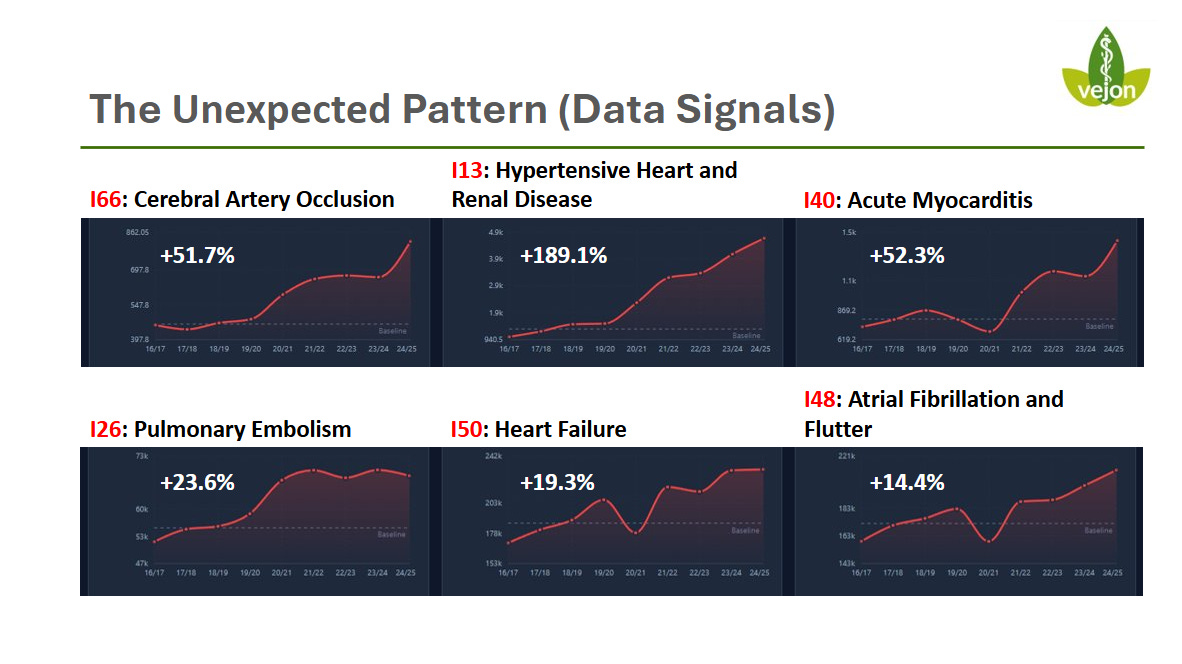
My analysis of English Hospital Episode Statistics does show a cardiovascular trajectory that deserves attention. Comparing the 2016-17 to 2019-20 baseline with 2021-22 to 2024-25, excluding the disrupted 2020-21 year and normalising against total primary-diagnosis episodes, acute myocardial infarction was essentially flat. The larger increases were in stroke, hypertensive disease, heart failure, myocarditis and pericardial disease, pulmonary embolism and other thrombotic diagnoses.
That mixed pattern does not support the simplistic claim that unstable coronary plaque is rising everywhere. It suggests something broader. Contemporary cardiovascular morbidity may increasingly involve endothelial, thrombotic, myocardial, renal and hypertensive disease that a conventional three-point MACE endpoint captures only partially.
The limitations are real. Finished consultant episodes are not unique patients. They do not measure incidence, persistent spike, macrophage activation or microclots. Coding practice, service recovery and repeated admissions can change the counts. These data are a signal requiring mechanistic investigation, not proof of cause.
But ignoring the signal because it does not fit the original trial model would be equally unscientific.
If spike-associated macrophage inflammation caused clinical events mainly through circulating IL-6, ziltivekimab should have intercepted at least part of that pathway. The null result challenges any simple sequence in which spike activates macrophages, macrophages release IL-6, and IL-6 alone destabilises plaque.
It pushes me toward a network explanation. IL-6 may be downstream rather than decisive. IL-1β, TNF, interferons, complement, tissue factor, platelets and endothelial injury may continue independently. Established plaque may be too advanced to modify. Infection caused by immune suppression may also offset a modest vascular benefit.
“They need to get back to basics and ask the question: Why is this happening, and how bad is it?”
I must also separate three questions that are too often collapsed into one: prior infection, persistence of viral or antigenic material after infection, and vaccination exposure. The evidence for infection-associated vascular inflammation is considerably stronger than the evidence that vaccination creates an equivalent chronic plaque process. A serious analysis is required to clarify these points.
How I Would Redesign the Question
I would not abandon inflammation as a cardiovascular target. I would abandon the assumption that one nonspecific biomarker defines one disease mechanism.
A contemporary trial should document infection and reinfection history, timing and severity; record vaccination timing and platform as a separate exposure; measure baseline IL-6 alongside IL-1β, TNF and interferon-related markers; characterise monocyte subsets, platelet-monocyte aggregates, tissue factor, endothelial injury and fibrinolysis; and include plaque imaging in a mechanistic substudy.
I would also examine cardiovascular events following incident infection and analyse serious infection as a competing risk. Above all, I would ask whether treatment response differs by inflammatory and immunothrombotic phenotype, rather than assume that everyone with an elevated CRP has the same disease.
“You cannot go forward at this point and exclude what has happened—and is still happening—from the pandemic.”
Stored ZEUS samples may still answer some of this. A subgroup with high baseline immunothrombotic activity that remained active despite CRP suppression would be highly informative. So would a subgroup in which IL-6 blockade did reduce plaque activity, but infection-related events erased the benefit.

Full Course with Dashboard and eBook >
Pharma Cannot Afford a Pre-Pandemic Model Forever
The long-term threat to pharmaceutical development is not that every cardiovascular drug will fail. It is that trials will keep spending enormous sums refining pre-pandemic models while refusing to measure plausible changes in population biology.
Pharma does not need to accept my hypothesis in advance. It needs to test it. If the hypothesis is wrong, good phenotyping will show that. If it is partly correct, ignoring it will produce repeated target failures, misleading biomarker success and declining public confidence.
“Too much of science is stuck in a narrative—and narratives don’t work when it comes to real-world problems.”
ZEUS has given us a clean result. Suppressing circulating IL-6 and CRP was not enough to reduce conventional MACE in an older population with advanced atherosclerosis and kidney disease. What it has not given us is a convincing explanation for why the disease continued.
That is the lesson I would not ignore. The biology of a population cannot be assumed unchanged simply because our trial templates are. If the disease environment has shifted, the cost of refusing to measure that shift will appear in failed drugs, impaired balance sheets and patients who still do not benefit.
Sources and methodological note
• ZEUS trial design and baseline characteristics — Ridker PM et al. JAMA Cardiology, 2026.
• ZEUS trial registration — ClinicalTrials.gov identifier NCT05021835.
• RESCUE phase II trial — Ridker PM et al. The Lancet, 2021.
• SARS-CoV-2 and coronary plaque macrophages — Eberhardt N et al. Nature Cardiovascular Research, 2023.
• Hospital Admitted Patient Care Activity, 2024-25 — NHS England. Earlier annual HES publications were also used in the author’s 2016-17 to 2024-25 analysis.
• Market report on the ZEUS result — Reuters, 31 July 2026.
Methodological note: the HES comparisons use primary-diagnosis finished consultant episodes, not unique patients or incidence rates. The author’s analysis compared 2016-17 to 2019-20 with 2021-22 to 2024-25, excluded the disrupted 2020-21 year, and normalised diagnosis groups against total primary-diagnosis episodes.


